A European alternative to MyFitnessPal: what to actually check
Where your food diary is stored, who pays for the free version, and whether the app knows what's on your shelf. How the usual calorie apps compare.
A lot of people are moving their everyday apps to European ones right now. Email, cloud storage, maps. Sooner or later the calorie tracker comes up, and it should, because a food diary is about as personal as data gets.
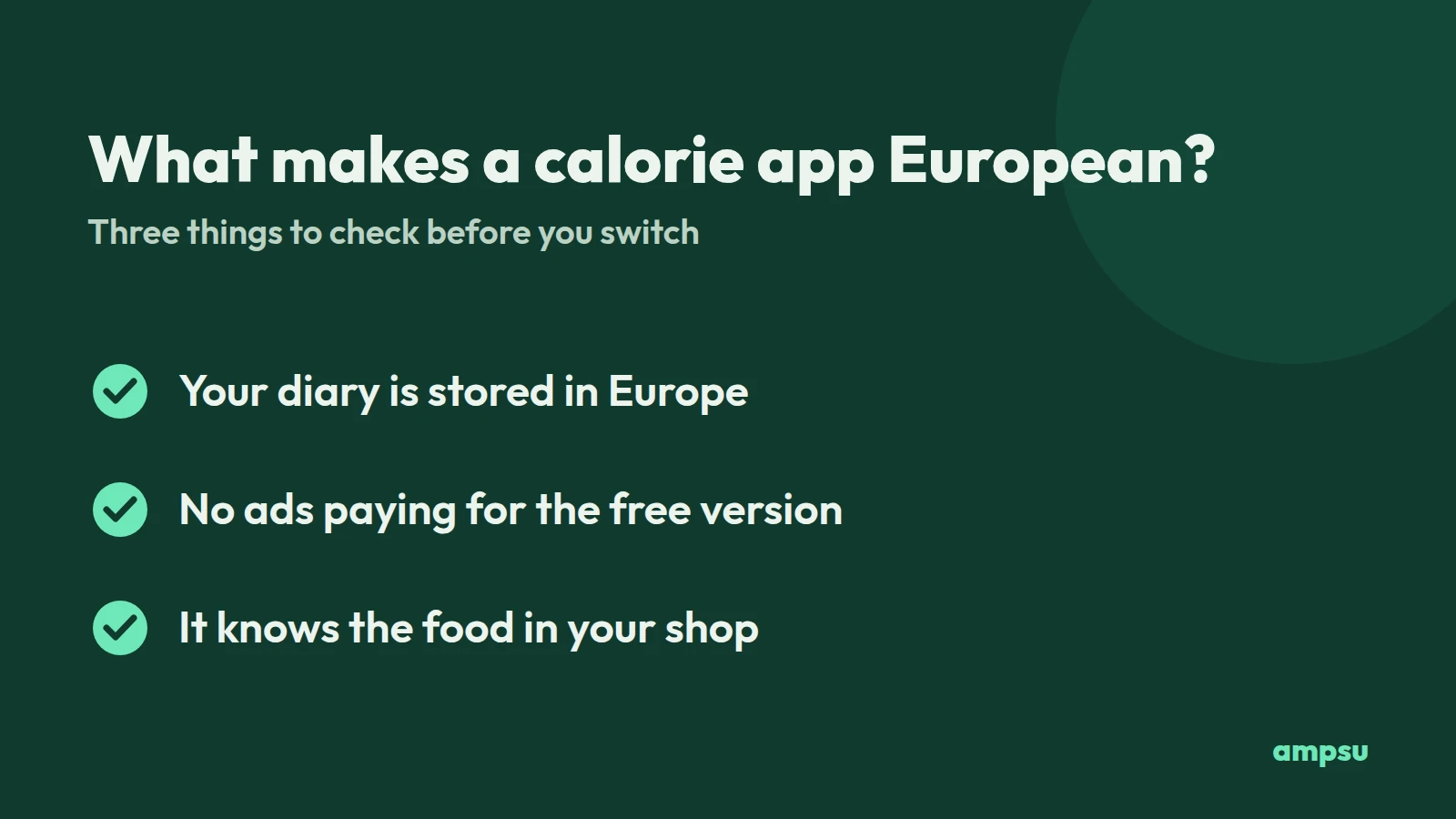
So, the short answer first. If "European" is going to mean anything for a calorie app, it should mean three things: your diary is stored in Europe, the free version isn't paid for with ads, and the app actually knows the food in your shop. Ampsu does all three. I built it, so of course I'd say that, which is why everything below links to each company's own policy and you can check my homework.
Isn't a German or Swedish app European enough?
Where a company is registered and where your data goes are two separate questions.
Yazio is German, and its help centre says its servers run in Germany. Good. Its privacy policy also lists Google Ads remarketing and AppsFlyer in the app, with Outbrain and Taboola on the website. Lifesum is Swedish, and its policy includes retargeting customers on third-party platforms. Fitatu is Polish, processes data on EEA servers "as a rule", and names Google Ads, DoubleClick and the Facebook Pixel. FDDB is German and runs Google AdSense on its website.
None of that makes them bad apps. Fitatu's Polish food database is very good, and FDDB has been the German food database for years. Most of those ad tools only switch on after you've agreed to them, too. It just means "made in Europe" and "kept out of the ad business" are two different promises.
Where does your food diary actually live?
| App | Company | Where your data is stored, in their words | Ads or ad tools |
|---|---|---|---|
| MyFitnessPal | US | "may be transferred to the United States" | Targeted advertising |
| Lose It! | US | "Our servers are based in the United States" | Behavioural advertising; may sell some data to advertisers |
| Cronometer | Canada | US servers | Ad networks for free users |
| MacroFactor | US | Google Firebase, USA | None |
| Yazio | Germany | Servers in Germany | Google Ads remarketing, AppsFlyer |
| Lifesum | Sweden | Not named; may leave the EEA | Retargeting |
| Fitatu | Poland | EEA servers "as a rule" | Google Ads, Facebook Pixel |
| FDDB | Germany | Website on AWS in Luxembourg; app not stated | AdSense on the website |
| Ampsu | Estonia | Frankfurt, Germany | None |
From each company's privacy policy as published on 6 November 2026. Policies change, so click through before you decide.
Who pays for the free version?
A free app gets paid for somehow, and with ads it's the advertisers paying.
MyFitnessPal says plainly that it "engages in targeted advertising". Lose It! goes further: its policy says it "may also sell or transfer Online Data to certain third parties such as advertisers". Cronometer doesn't sell personal information, but shares some with ad networks for people on the free plan. MacroFactor skips ads and charges for the app instead, which is a fair deal, though your diary then sits on US servers.
Ampsu has no ads, and no advertising or install-tracking tools inside the app. It doesn't sell your data or build a profile out of it. It's free right now, everything included.
And when does something leave Europe?
Plenty of "EU-hosted" claims go vague at this point.
Your Ampsu account, diary and backups stay in the EU. Three things can send something outside it, and you choose each of them: scanning a label or a meal photo, where the picture goes to an AI service that reads it; signing in with Google instead of email; and connecting your own AI assistant to your diary. Type your food in, sign in by email, and nothing leaves the EU. The privacy policy says the same thing.
Will it find the food in your shop?
Scan an own-brand yoghurt from Lidl, Rimi or Carrefour in a US-built app and there's a decent chance nothing comes back. Supermarkets give their own-brand products barcodes from a range they hand out themselves, so a lot of those codes never made it into the big global databases.
Ampsu's catalogue is built around European shelves, own-brands included. The deli-counter stickers, the ones with a new barcode every time, you teach once and it remembers.
How do I check an app myself?
Five minutes, three things:
- Open the privacy policy and search for "sell", "advertis" and "transfer". Those three words tell you most of the story.
- On the App Store page, look for "Data Used to Track You". If anything is listed there, the app shares data with other companies for advertising. Developers fill those labels in themselves, so read them as the minimum.
- Find out where the servers are. If the policy only says your data "may be transferred outside the EEA", assume it is.
Can I bring my history with me?
Yes. Export your diary from MyFitnessPal or Cronometer as a CSV file and import it in Ampsu's settings, and your past days come along.
If you want to try it, install Ampsu and scan three things from your fridge.