A worked example
An 80 cm waist and 170 cm height give a ratio of 0.47, under the 0.5 line. Half that height is 85.0 cm, so that’s the waist size to stay below.
What does 0.5 mean?
A ratio of 0.5 means your waist is half your height. NICE guidance for adults treats under 0.5 as no increased health risk from central fat, 0.5 to 0.59 as increased, and 0.6 or more as high. The ratio alone can’t diagnose anything, but it’s a good reason to look closer.
The same 0.5 line works for most adults whatever their height, sex or ethnicity, which is part of why it’s gaining ground on BMI as a first check.
Waist sizes by height
The waist at which each band starts: under the first column is below 0.5, from the second column up is 0.6 or more.
| Height | 0.5 | 0.6 |
|---|---|---|
| 150 cm (59.1 in) | 75 cm (29.5 in) | 90 cm (35.4 in) |
| 155 cm (61 in) | 77.5 cm (30.5 in) | 93 cm (36.6 in) |
| 160 cm (63 in) | 80 cm (31.5 in) | 96 cm (37.8 in) |
| 165 cm (65 in) | 82.5 cm (32.5 in) | 99 cm (39 in) |
| 170 cm (66.9 in) | 85 cm (33.5 in) | 102 cm (40.2 in) |
| 175 cm (68.9 in) | 87.5 cm (34.4 in) | 105 cm (41.3 in) |
| 180 cm (70.9 in) | 90 cm (35.4 in) | 108 cm (42.5 in) |
| 185 cm (72.8 in) | 92.5 cm (36.4 in) | 111 cm (43.7 in) |
| 190 cm (74.8 in) | 95 cm (37.4 in) | 114 cm (44.9 in) |
| 195 cm (76.8 in) | 97.5 cm (38.4 in) | 117 cm (46.1 in) |
| 200 cm (78.7 in) | 100 cm (39.4 in) | 120 cm (47.2 in) |
How to measure
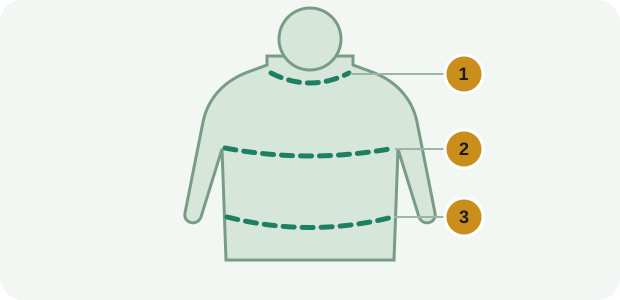
Find the bottom of your lowest rib and the top of your hip bone, and measure halfway between them. Breathe out normally, keep the tape level and snug without pulling it in. Doing it the same way each time matters more than chasing a tenth of a centimetre.
Questions people ask
Is waist-to-height better than BMI?
It tells you something BMI doesn’t: where the weight sits. Fat around the middle is linked to heart disease and type 2 diabetes more closely than overall weight. Looking at both is better than either alone.
Does it work for children?
NICE’s bands are for adults. For children the ratio is used differently, so check with a health professional.
Can I use inches?
Yes. Switch the units to imperial. The ratio is the same whichever unit you use, as long as both measurements are in it.