Menopause weight gain: what actually changes, and what helps
Weight doesn't speed up at menopause, but fat gain doubles while muscle shrinks. What the studies show about metabolism, sleep and HRT, and what helps.
"I eat exactly what I always ate, and the weight keeps creeping on." If you're somewhere in your mid-forties to mid-fifties, there's a fair chance you've said something like that, or heard a friend say it. Usually followed by: "It's the menopause. My metabolism has gone."
Some of that is true and some of it isn't. A large study that followed women through menopause found that the rate of weight gain didn't actually speed up. What changed was underneath: fat started building twice as fast while muscle and other lean tissue shrank, and more of the fat settled around the middle. Sleep and everyday movement often get worse at the same time, and those make a bigger difference to the numbers than people expect.
That's useful, because it points at what helps: keeping muscle, sleeping where you can, and checking your calorie target against the body you have now rather than the one you had at 40.
Does menopause make you gain weight?
Not in the way it's usually described. The SWAN study, which followed women across the United States for years and measured their body composition with DEXA scans, found that weight climbed steadily in the years before menopause and didn't accelerate when the transition started. After the transition, it levelled off.
The composition was another story. From the start of the transition, the rate of fat gain doubled, and lean mass started to fall. Both kept going until about two years after the last period, then flattened out.
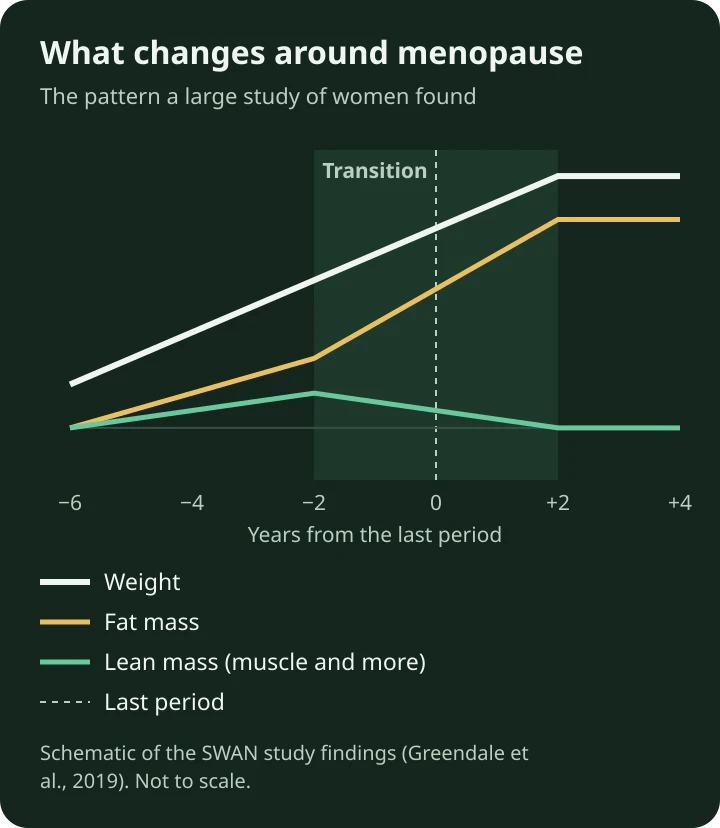
So the scale can look similar to before while the body changes shape. Clothes fit differently, the waist grows, and it feels like "everything goes to my stomach now", even when the weight trend barely shifted.
Why does fat move to the belly?
Falling oestrogen seems to be a big part of it. A study that measured women's abdominal fat by CT scan for four years found that all of them gained fat under the skin over time, but only those who went through menopause gained significantly more deep belly fat, the kind around the organs. Their oestradiol levels dropped at the same time.
This is mostly something to understand rather than fight directly. No food or exercise targets belly fat specifically. What changes it is the same as anywhere else: a modest calorie deficit over time, and holding on to muscle.
Is it your metabolism slowing down?
A little, but less than it feels like. A large study of daily energy use across the whole lifespan found that, for the same amount of lean tissue, burn stays steady from about 20 to 60. In the CT study above, sleeping energy use did fall faster in the women going through menopause than in those who didn't (about 8% against 5% over four years), so there's something real there.
But the same study found a bigger, quieter change: physical activity dropped about two years before menopause and stayed lower. Less movement and less muscle both lower your daily burn. Neither is a broken metabolism, and both are things you can work on.
How does sleep come into it?
More than most people realise. Night sweats and hot flushes break up sleep, and short sleep changes how much you eat. A meta-analysis of sleep-restriction studies found people ate about 385 kcal more the day after short sleep, with no change in what they burned. A few bad nights a week can quietly add up to the creep you see on the scale.
If sleep is the problem, it's worth treating as a real problem, including talking to your doctor about symptoms. Better sleep is one of the few things that helps hunger, mood and the scale at once.
Does HRT make you put on weight?
The evidence says no. A Cochrane review of the trials found no difference in weight gain between women taking oestrogen, with or without progestogen, and women not taking it. Whether HRT is right for you is a decision about symptoms and health for you and your doctor. Fear of weight gain shouldn't be the reason to rule it out.
What actually helps?
- Lift something heavy two or three times a week. It's the most direct way to push back on the loss of lean mass. Weights, resistance bands or bodyweight exercises all count, as long as they get harder over time.
- Eat enough protein. Around 1.6 g per kg of body weight a day is a sensible target alongside strength training, since studies found the benefit levelled off at about that point. For a 70 kg woman that's roughly 110 g, spread over the day. This look at high-protein foods shows which ones give you the most for the calories.
- Keep the steps up. Daily movement is the part that tends to slip first. A walk after dinner does more than people give it credit for, and the steps calculator shows roughly what your walking adds.
- Check your calorie target against now. With a bit less muscle and a bit less movement, your maintenance may be lower than it was five years ago, even if your weight is the same.
- Judge by the trend, not the day. Hormonal swings make day-to-day weight even noisier than usual. Look at weekly averages over a month or more.
How do I find out what I really burn now?
Calculators guess from height, weight and age, and they don't know that your activity dropped or your muscle shrank. Your own numbers do. Log roughly what you eat for three or four weeks and weigh yourself a few times a week. If you ate about 1,900 kcal a day and still gained 0.4 kg over four weeks, your real burn is closer to 1,790.
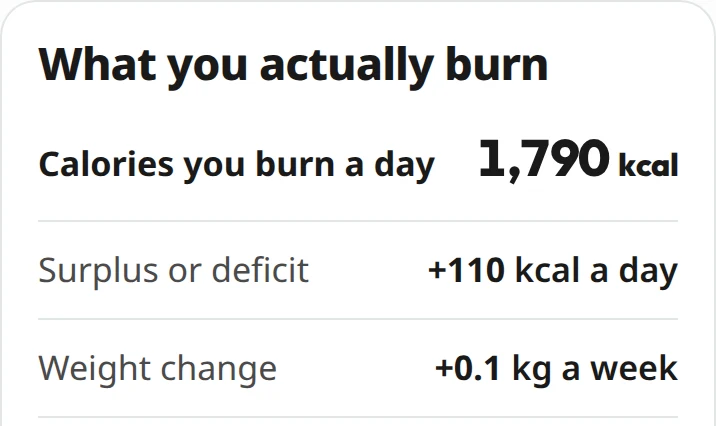
The TDEE-from-your-log calculator does this from your own figures, and Ampsu does the same continuously in the app, adjusting your target as your real burn shifts. From there, a gentle deficit of about 15 to 20% is a good place to start. This explainer on calorie deficits goes through how to pick yours.
Your first step
Pick one strength session you can do this week, even a short one at home, and start logging roughly so that in a month you know your real number instead of the one on a calculator.