What is a calorie deficit, and how big should yours be?
A calorie deficit explained: how big it should be (usually 15 to 25% below maintenance), why 500 kcal a day isn't quite 0.5 kg a week, and how to find yours.
Every weight-loss article says the same thing: eat in a calorie deficit. Fair enough. But how big a deficit? A calculator tells you 1,550 kcal, a friend swears by 1,200, someone online cut 1,000 a day and lost 6 kg in a month, and you're left wondering which of these is actually sensible.
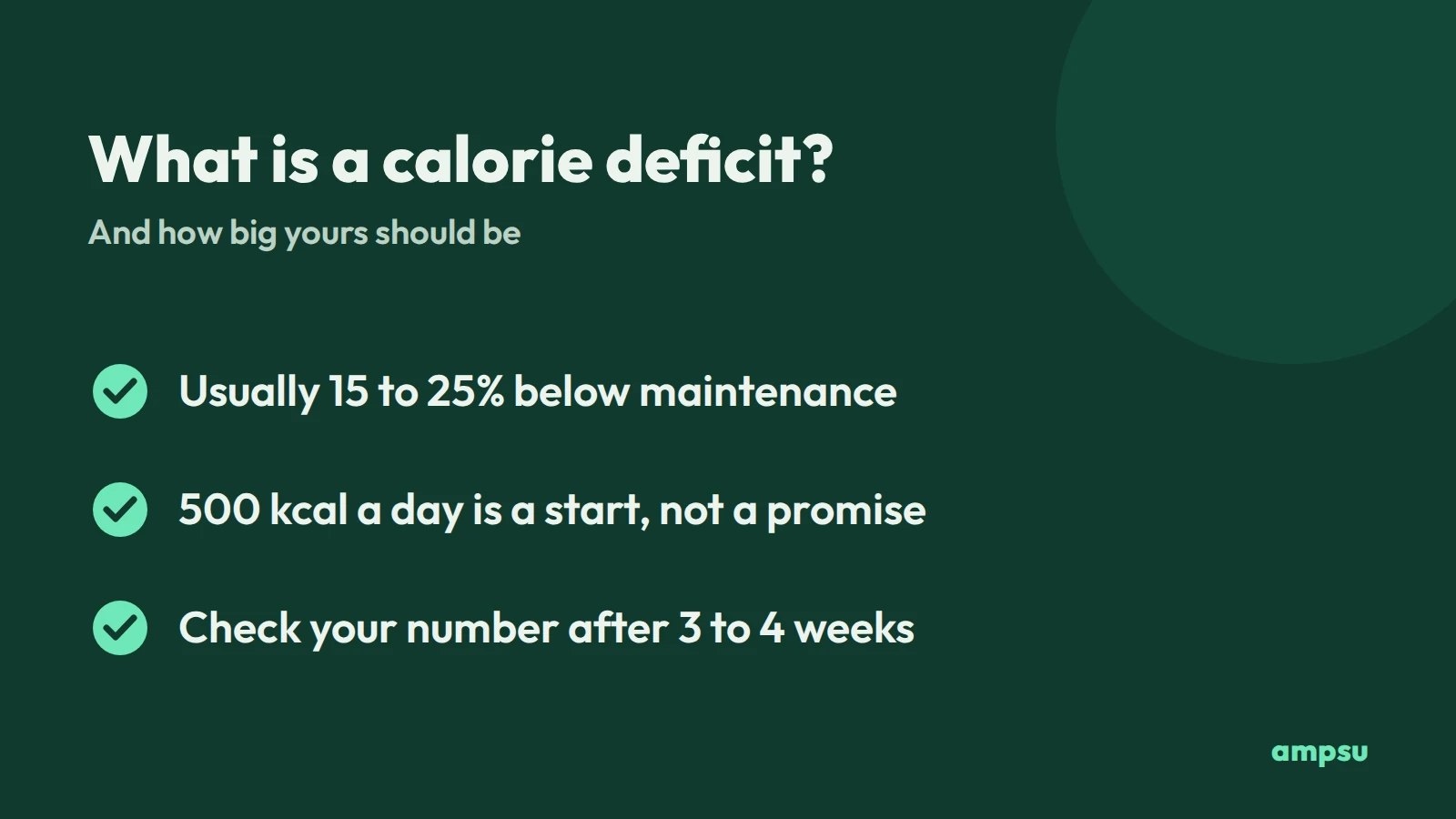
Short answer: a calorie deficit means eating less energy than your body uses, so it makes up the difference from its stores, mostly fat. For most people a good size is about 15 to 25% below maintenance, which usually lands somewhere between 300 and 600 kcal a day. The NHS suggests about 600. Start at 20%, give it three or four weeks, and adjust from what the scale does.
Here's how to work out your number, why 500 kcal a day doesn't quite mean half a kilo a week, and when a bigger deficit stops being worth it.
What is a calorie deficit?
Your body burns a certain amount of energy every day: keeping you alive, digesting food, walking to the shop, training if you train. That total is your maintenance, the amount you'd eat to stay the same weight. Calculators call it TDEE, total daily energy expenditure.
Eat less than that and you're in a deficit. Say your maintenance is 2,100 kcal and you eat 1,700. The missing 400 kcal still has to come from somewhere, so your body takes it from storage. Do that most days for a few months and your weight trends down.
That's really all it is. The tricky parts are knowing your maintenance (calculators guess it) and picking a deficit you can live with.
How big should my calorie deficit be?
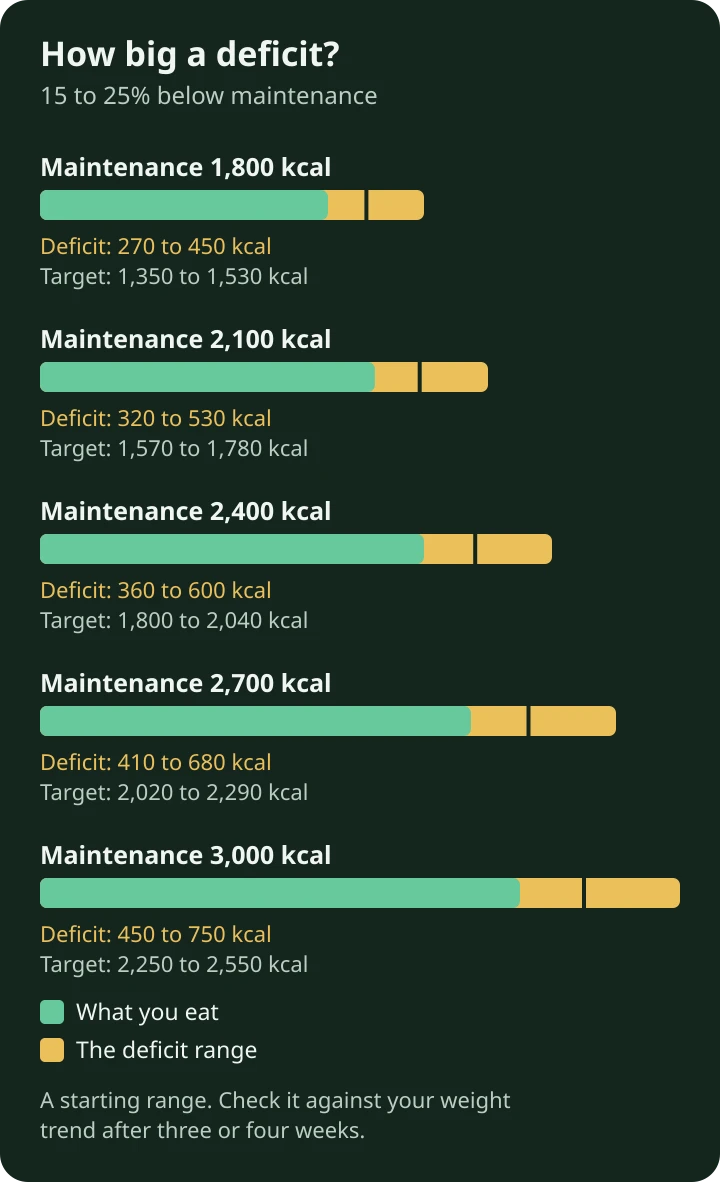
Big enough to see progress within a month, small enough that you're not hungry and grumpy all the time. A percentage of your maintenance scales better than a fixed number, because 500 kcal is a gentle cut for someone burning 3,000 and a hard one for someone burning 1,700.
A useful cross-check is the rate. Losing about 0.5 to 1% of your body weight a week is what sports nutrition reviews recommend for keeping muscle. For an 80 kg person that's 0.4 to 0.8 kg a week, at least after the first couple of weeks, when water muddies everything.
Slower tends to be easier on muscle too. In a study of athletes who all strength trained, the group losing about 0.7% a week gained a little lean mass, while the group losing 1.4% a week didn't. The faster group did reach its goal sooner, which is the trade-off.
So a sensible default: take 20% off your maintenance. If after three or four weeks your weekly average hasn't moved, take off another 100 to 150 kcal. If you're losing faster than 1% a week and feel rough, add some back.
Does a 500 calorie deficit really mean half a kilo a week?
As a starting estimate, roughly. The usual rule says a kilo of body fat holds about 7,700 kcal, so 500 kcal a day is 3,500 a week, about 0.45 kg. It's useful planning arithmetic, and it's also a simplification: the first week drops more than that (water), and later weeks drop less.
The later slowdown is the part people don't expect. As you get lighter, you burn less: a smaller body costs less to run and to carry around. So the same 1,700 kcal that was a 400 kcal deficit at the start is a smaller one ten kilos later.
Researchers at the US National Institutes of Health put a rough number on it. For an average overweight adult, every permanent 100 kJ (about 24 kcal) cut from daily intake eventually moves weight by about 1 kg, with half of that change coming in the first year and almost all of it within three.
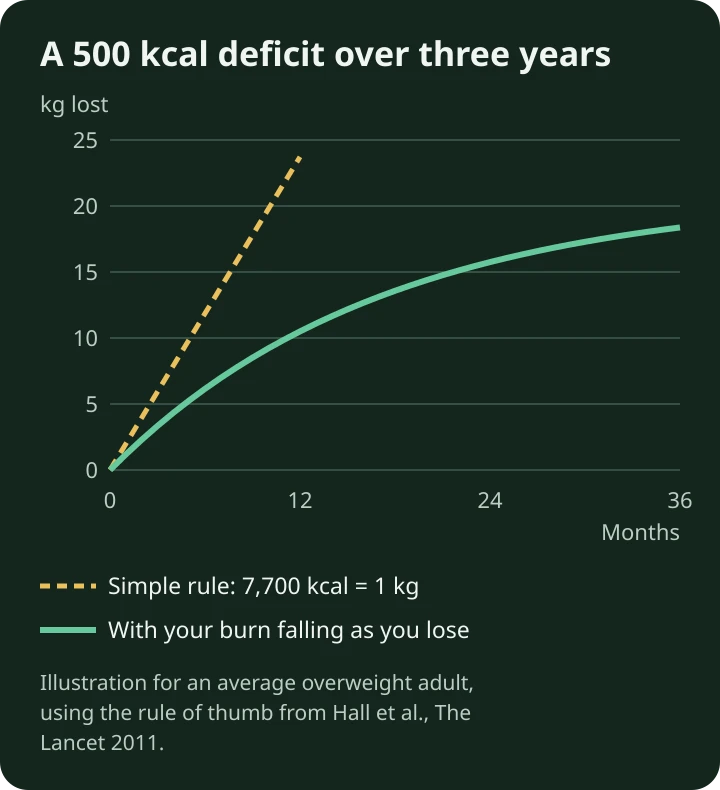
The deficit is still doing its job; your maintenance moved underneath it. That's why a target set in January needs checking again in March.
How do I find my own deficit?
Start with a calculator, then let your own numbers take over.
- Get a starting estimate. The calorie deficit calculator estimates your maintenance from your height, weight, age and activity, and gives you a target with the deficit already taken off.
- Log your food and weigh in for three or four weeks. Roughly is fine. You're collecting evidence, and nobody's marking it.
- Compare the weekly averages. If your weight trend fell about as expected, the estimate was right. If not, your real maintenance is different, and your logs plus your weight trend tell you by how much.
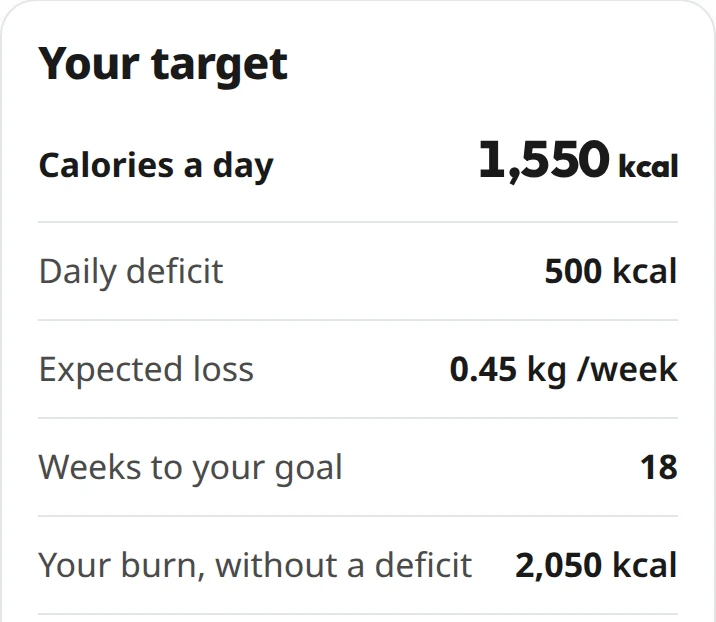
Step three is the one that turns a guess into your number. If you have a few weeks of logs and weigh-ins, the TDEE-from-your-log calculator works your maintenance out from them. Ampsu does the same thing continuously in the app and adjusts your target as your burn changes, so the January target doesn't quietly turn into the wrong one by March.
Can you build muscle in a calorie deficit?
Yes, especially if you're new to strength training or coming back after a break. It's slower than building muscle while eating more, but it happens. Two things make it much more likely:
- Lifting something heavy two or three times a week. The muscle needs a reason to stay.
- Enough protein. In strength training studies, benefits levelled off at around 1.6 g per kg of body weight a day. For a 70 kg person that's about 110 g. The protein calculator gives you a range for your own weight.
And keep the deficit moderate. The slower athletes in the study above were the ones who gained lean mass.
What about a 1,000 calorie deficit?
For someone with a high maintenance, say 3,200 kcal, a 1,000 kcal deficit is about 30% and can work for a while. For someone burning 1,900, it would mean eating 900 kcal a day, which is hard to keep up, hard to get enough protein from, and the kind of target to talk through with a doctor first.
Big deficits also tend to backfire in a quieter way: hunger builds, the weekend undoes the week, and the average deficit across the month ends up smaller than a moderate one you'd actually have kept. A deficit only counts on the days you eat it.
What if I'm in a deficit and not losing weight?
It happens to almost everyone at some point, and it's usually one of three things: water hiding a loss, a deficit that's smaller than you think because portions and cooking oil crept in, or maintenance that dropped as you lost weight. This explainer on stalls in a deficit walks through how to tell which.
Your first step
Work out your maintenance, take 20% off, and log roughly for three weeks before you judge anything. If it helps to see the numbers, the deficit calculator does the first part in about a minute.