Why am I not losing weight in a calorie deficit?
Logging your meals but the scale won’t budge? Before eating less, check the weight trend, the whole week of food and the estimate behind your target.
You’ve logged your meals, counted the oil in the pan and remembered the milk in your coffee. You’ve done the admin. Then you step on the scale and get 79.8 kg, a number you’re getting thoroughly bored of seeing.
It’s tempting to make tomorrow’s dinner smaller before you’ve even had breakfast. I’d hold off for a moment. We need to find out whether your progress has stopped, or whether today’s reading is doing a poor job of showing it.
A few unchanged weigh-ins can hide a falling trend. And the deficit shown in an app depends on estimates of both what you ate and what you burned. Before cutting more food, look at those two histories together.
What did the rest of the month look like?
A bathroom scale is very good at adding everything up. Explaining which bit changed is where it becomes less helpful.
That weight includes water, muscle, bone and fat, plus food and drink still passing through you. So the number can move without the same change in body fat, or stay put while other changes are happening.
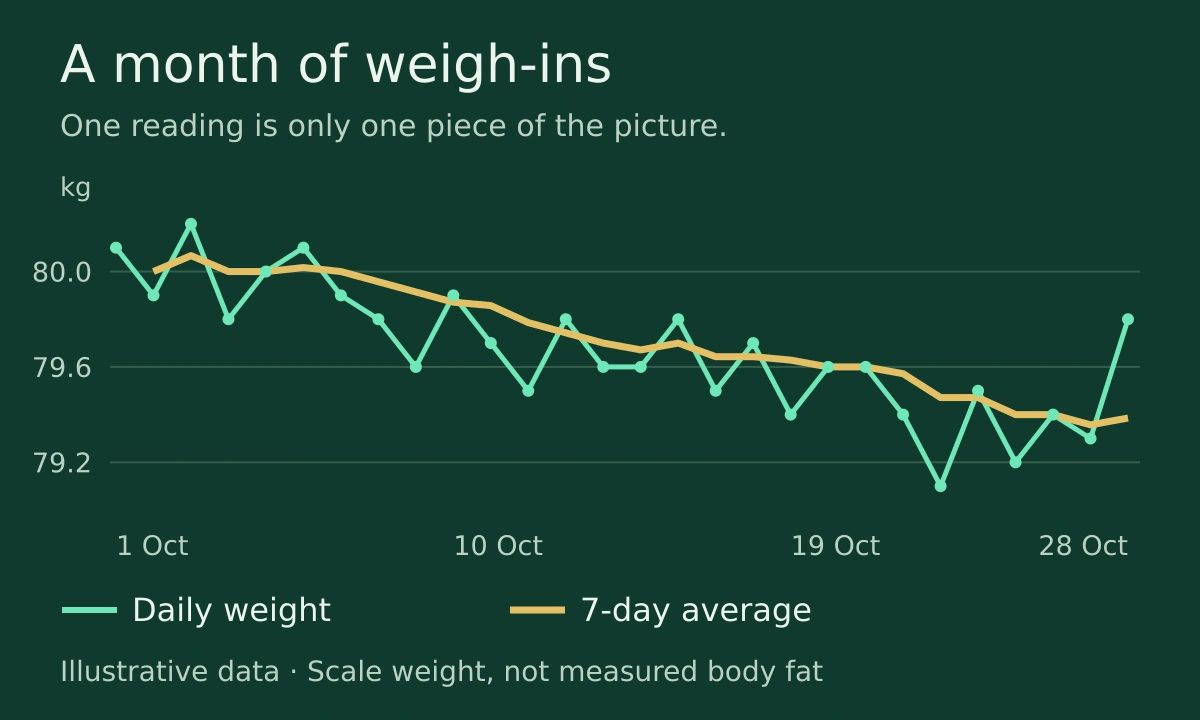
Here’s a made-up month. The final reading is 79.8 kg, which also appeared earlier on. If you picked those two mornings, you could make a convincing case that nothing had happened. Now look at the weekly averages:
| Week | Readings | Average weight |
|---|---|---|
| 1–7 October | 7 | 80.0 kg |
| 8–14 October | 7 | 79.7 kg |
| 15–21 October | 7 | 79.6 kg |
| 22–28 October | 7 | 79.4 kg |
That last 79.8 looks rather different with the rest of the month around it. The averages, rounded to one decimal place, are falling. This still doesn’t measure fat loss or tell us what caused a particular bump. It does show why a familiar number can give you the wrong impression.
If you already have several readings a week, add that week’s weights and divide by the number of readings. A rolling seven-day average does a similar job, moving the window along each day. You’re giving the quieter pattern a chance to show through.
Give the scale a fair comparison
Yesterday before breakfast and today after dinner are asking it two different questions. Use the same scale on a firm, level surface, at a similar time and in similar clothing. Morning, after using the toilet and before eating or drinking, is a useful routine. That’s also the approach in NHS weighing guidance.
Daily weighing is optional. Weekly is fine too, though fewer readings can take longer to reveal a pattern. If weighing every morning makes the rest of the day about weighing, step back from it. You don’t owe the chart more data at the expense of your peace of mind.
Even with the same routine, mornings aren’t identical
Your body stores carbohydrate as glycogen, with water alongside it. Changing carbohydrate intake can change both. Researchers measured this in a small carbohydrate-loading experiment, although that doesn’t give us a kilogram forecast for your next bowl of pasta.
Salt can affect fluid balance as well. A controlled sodium study found changes in thirst and small weight differences. After eating out, fluid and food still in your digestive system can both be part of a higher reading. The scale can’t separate them out for you.
If you menstruate, the calendar can add useful context. A study following 42 women through a cycle found weight differences alongside changes in extracellular water. Comparing similar stages of your own cycle may tell you more than comparing any two neighbouring weeks. The timing and size of changes vary.
A new lifting routine deserves a note too. Research in new lifters found that early increases in measured muscle size included swelling. That can complicate the picture, though it doesn’t tell us how much of your particular scale reading came from it, or prove that a stall is new muscle.
So keep a short note when something changes. You don’t need to remove carbohydrate or try to sweat water away to get a more pleasing number tomorrow. The point of weighing is to learn what’s happening. It becomes much less useful when you start arranging your day around making the reading smaller.
Okay, but what if the average really is flat?
Then I’d open the food diary before lowering the target. A log can be incomplete even when you’ve been carefully filling it in, and it’s usually easier to check a few familiar entries than to start eating less on a hunch.
Look at an ordinary day. Did the cooking oil make it in? The sauce, the coffee, the drink with dinner? The NHS calorie-counting guide calls out oils, spreads, toppings and sauces because they’re easy to leave out.
Then check the amounts. Scanning a packet tells the app what’s in the food; you still have to tell it how much you ate. A perfectly accurate entry for 100 g won’t help much if your portion was 180 g.
Raw and cooked entries are another easy mix-up. Dry pasta and cooked pasta have different weights because of the water involved. Match the entry to what you weighed; the raw-to-cooked calculator walks through it. For a whole homemade dish, add up the ingredients, enter the finished weight and log your share.
And look for the days that stop halfway through. Breakfast and lunch might be beautifully recorded, but if dinner never made it in, the total is answering a rather limited question.
You don’t need to weigh every cucumber forever. Check your usual portions and the entries you use repeatedly. Keep restaurant meals as sensible estimates. A short review should make the diary more useful, without turning every meal into extra homework.
The rest of the week counts too
Take a separate example: five days at 1800 kcal and two at 3000 kcal. None of these amounts is a suggested target. We’re looking at what happens when you average the whole week:
(5 × 1800 + 2 × 3000) ÷ 7 = about 2143 kcal a day.
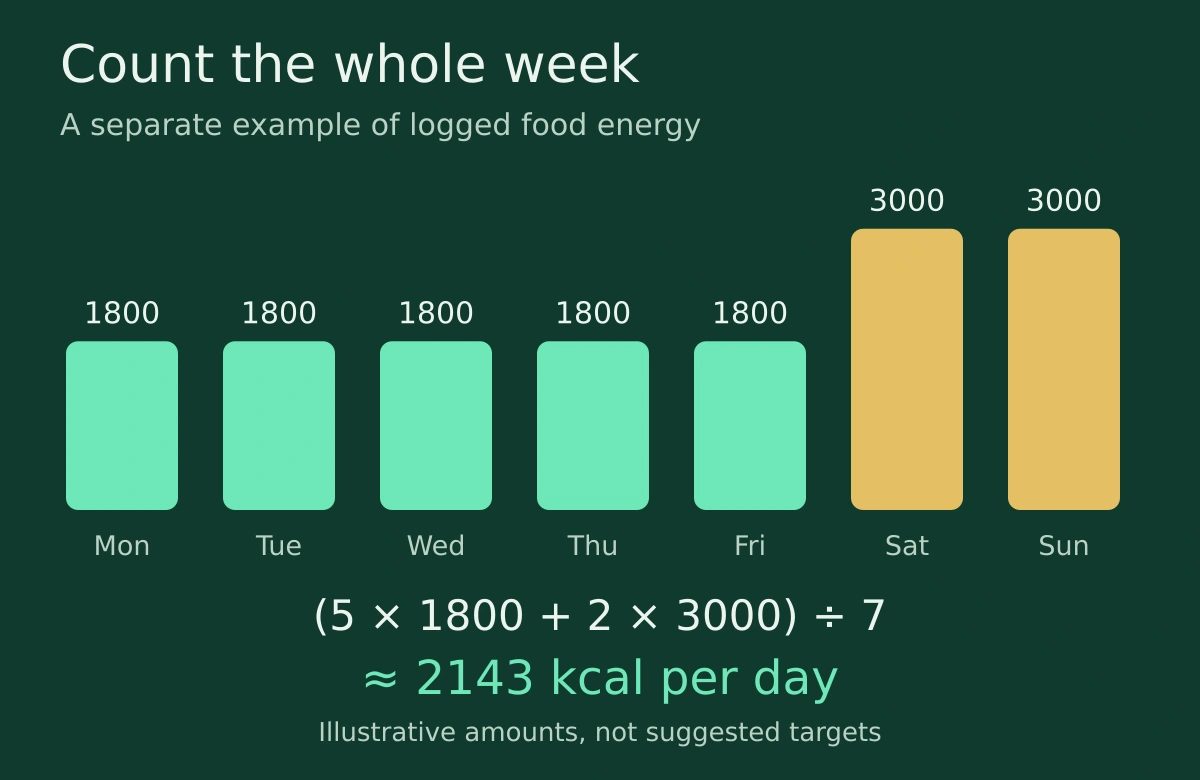
If estimated maintenance were 2200 kcal, those five lower days would each be 400 below the estimate. Across the whole week, though, the difference would average only about 57 kcal a day. An error in the maintenance estimate could change whether this was a deficit at all.
A diary that stopped on Friday could make this look like an 1800 kcal week. You can see how that would send the next calculation in the wrong direction. Include all seven days, including the approximate ones, before deciding what to change.
And if the food log checks out?
The other side of the calculation deserves the same attention. A calorie deficit means taking in less energy than your body uses over time. Being below a target in an app tells you how you compare with an estimate; it doesn’t directly measure that gap.
A calculator takes your age, size and activity level and produces a satisfyingly precise number. But “moderately active” covers a lot of different Tuesdays. Use a daily calorie-burn calculator as a starting point, then compare the estimate with what happens over time.
The starting point can also get out of date. A smaller body generally needs fewer calories after weight loss. Energy expenditure can adapt during dieting, and your everyday movement may change. NIDDK explains these changing calorie needs. A target that used to produce a deficit can end up closer to maintenance.
That’s one reason research on body-weight change accounts for changing energy needs and body composition. You can’t keep extending the first week’s rate down a ruler and expect your body to follow the line.
Check exercise accounting too. If your activity setting already includes your usual training, adding the same exercise calories again can overstate the total. A watch doesn’t remove all the uncertainty: a laboratory study of seven wrist-worn devices found substantial errors in energy-expenditure estimates. Those were older devices, so it doesn’t give us an error percentage for your current watch.
A stall alone can’t tell you that your metabolism is broken. And an app can’t reliably untangle every missing food entry from every change in calorie burn using weight alone. Both deserve a look before you decide which number to change.
Let the app do some of the remembering
By now there are enough moving parts without trying to remember what you ate three weeks ago. Keep the food history and weigh-ins together. In Ampsu’s Stats, the weight chart shows individual readings and a seven-day average. Here’s that example month inside the real app:
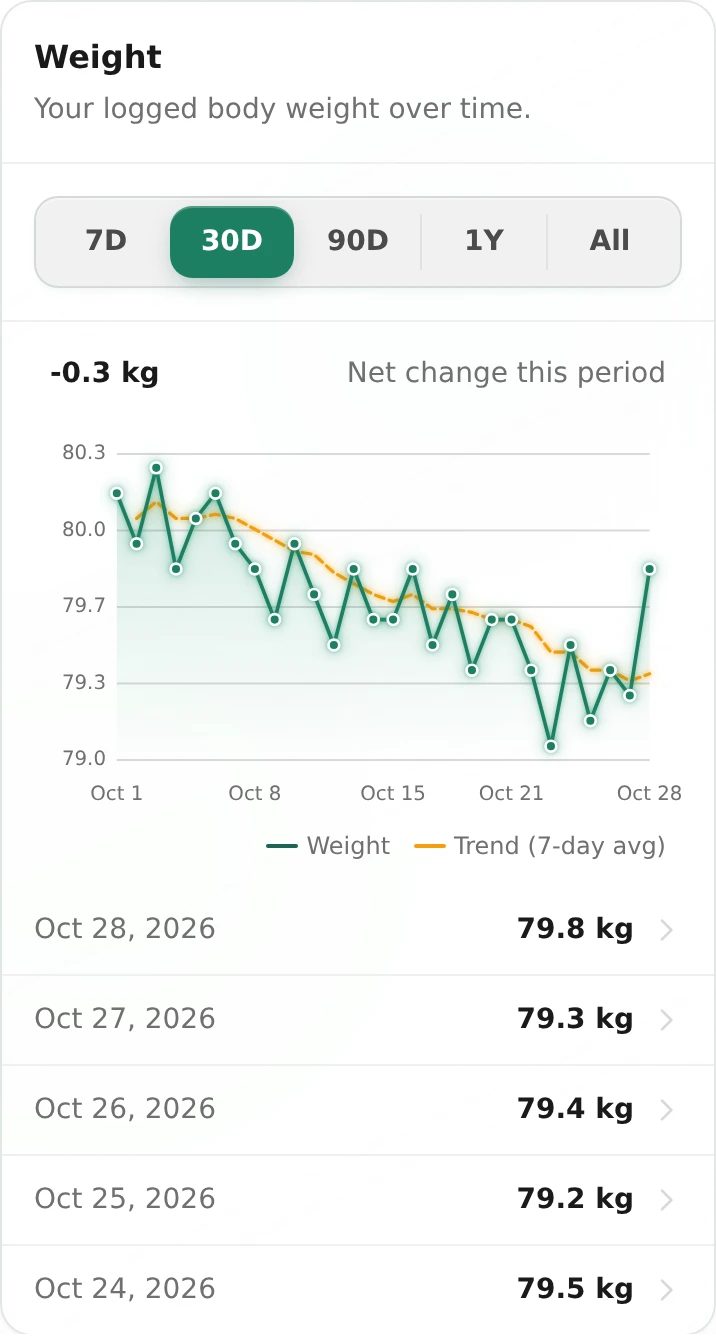
Metabolism mode uses your food logs and weight history to estimate daily calorie burn as more information arrives. The card calls it TDEE: total daily energy expenditure. Notice the confidence line underneath:
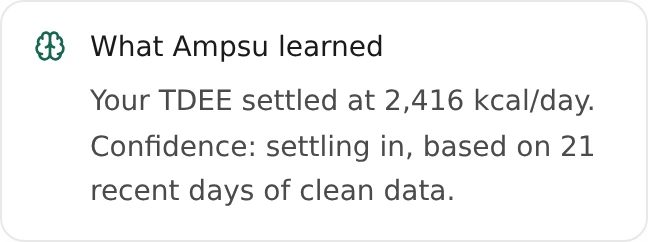
A number with four digits can look very sure of itself. It still depends on the logs and weigh-ins behind it. The guide to Metabolism mode explains how the estimate works and where it can be wrong.
If having those histories together would help, open your stats in Ampsu. The checking process works in a notebook or spreadsheet too.
So, do I change my target?
A few mornings give you little to go on. A practical point to review the plan is after roughly two to four weeks of comparable weigh-ins and reasonably complete food records. That’s a way to organise a check, not a medical definition of a plateau. Cycle-related changes, infrequent readings or a very small planned deficit can need more context.
If the broader trend is falling and you feel well, a brief flat patch alone isn’t a reason to lower the target. If it has stayed flat across several weeks, check the entries and the burn estimate first. Then consider one sustainable change to food portions or activity, and keep enough comparable records to see what happens. Changing everything at once makes it harder to learn which bit helped.
Leave yourself meals you actually want to eat. The guide to making dinner filling while eating fewer calories has some practical examples. Getting stuck shouldn’t mean that every meal gets a little less appealing.
What if I’m already eating 1200 kcal?
Then please don’t read this as “try 1100”. Check whether the figure covers complete days and whether the weight history is long enough to interpret, then discuss the plan with a registered dietitian or clinician.
NICE guidance treats diets of 800–1200 kcal a day as low-energy interventions to use with specialist support in specific circumstances. It isn’t a default target for everyone. Persistent dizziness, exhaustion or distress around eating deserves support before you reduce food further.
For now, put today’s number in the diary and look at it alongside the rest of the month. When you review the plan, include the whole record, even the imperfect days. It gives you something much more useful to work with than another morning of staring at 79.8.