How to calculate calories in homemade food
Add up the ingredients, weigh the finished dish and calculate your portion. A worked pasta example covers oil, cooked weights, servings and leftovers.
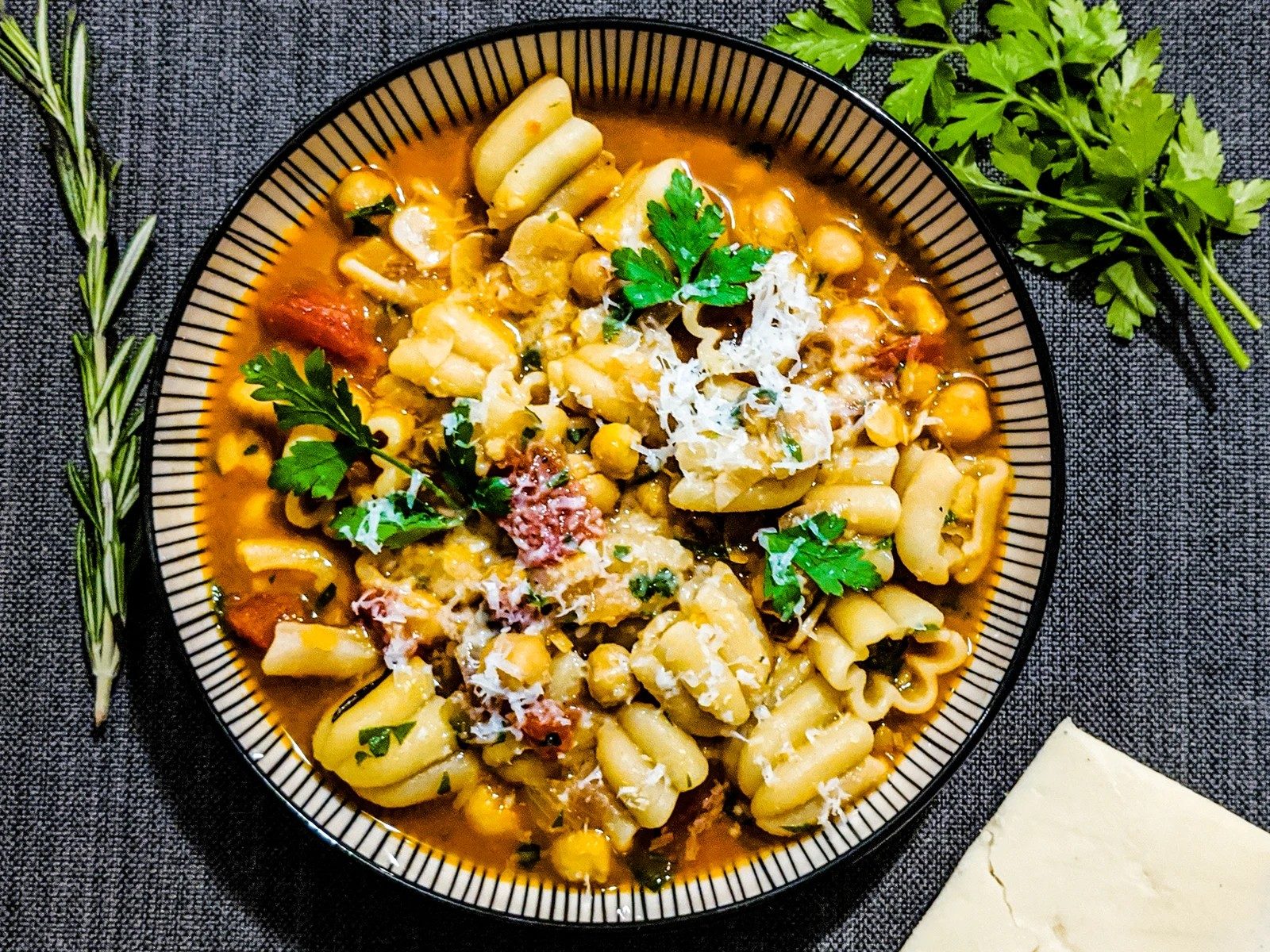
Cover photo for illustration; the calculation below uses a separate worked example. Photo: PilotChicago, CC BY-SA 4.0. Resized and displayed with a crop; this version uses the same licence.

You’ve made a pan of pasta. There’s a tin of chickpeas in it, some tomato sauce, an onion and the oil you used to cook it. Your food diary offers “homemade pasta, one serving”. Whose serving?
You can get a much more useful estimate from your own ingredients. Add up their calories, weigh the finished food, then work out how much of that batch ended up on your plate. Once you’ve done it for a meal you cook often, you can save the recipe and stop rebuilding dinner from scratch in your diary.
The short answer
To calculate calories in homemade food, use:
Portion calories = total recipe calories × portion weight ÷ finished recipe weight.
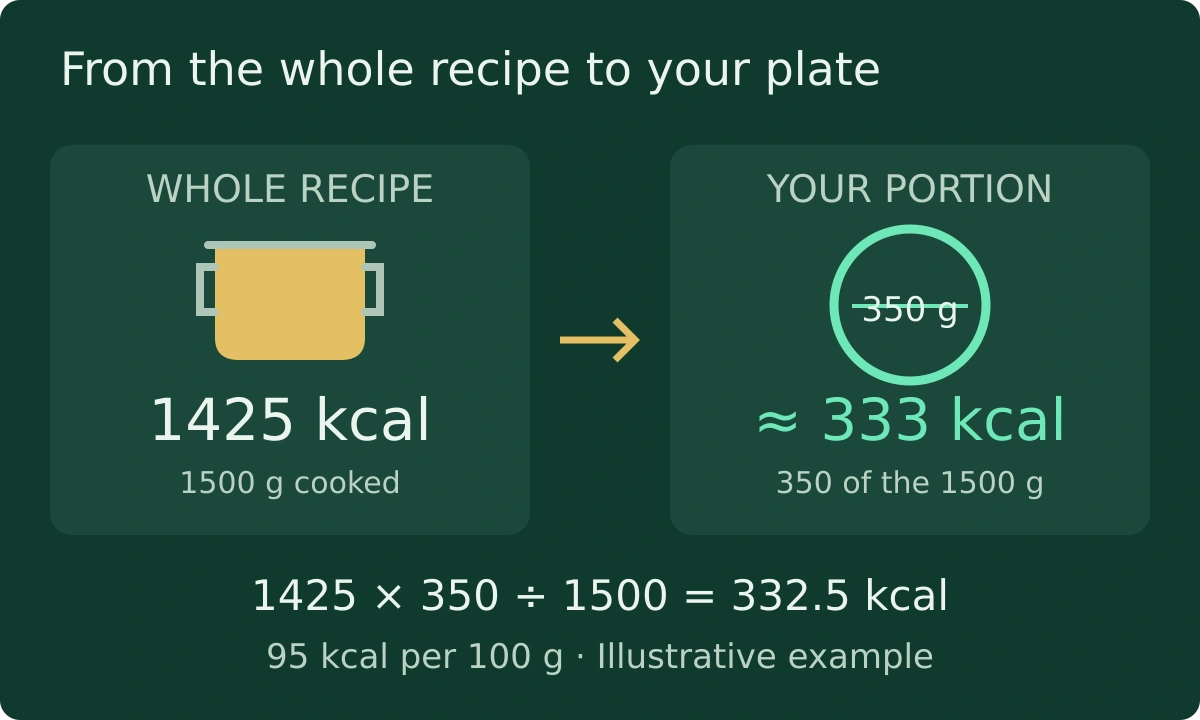
All the weights in that calculation need to be in the same unit. We’ll use grams. For an example batch with 1425 kcal weighing 1500 g after cooking, a 350 g portion has 1425 × 350 ÷ 1500 = 332.5 kcal. Call it about 333 kcal in your diary.
That’s the whole method. The fiddly bit is making sure the ingredients and weights describe what you actually cooked.
1. Start with the ingredients that go into the pan
For each ingredient, you need its amount and its calorie value. On European packaging, look for the kcal per 100 g figure. Nutrition information is given per 100 g or 100 ml, and may also show a manufacturer’s portion. That portion can be quite different from yours. The European Commission explains the label format.
The calculation for one ingredient is:
Ingredient calories = grams used × kcal per 100 g ÷ 100.
So 250 g of dry pasta at 350 kcal per 100 g contributes 250 × 350 ÷ 100 = 875 kcal. If the packet gives kilojoules as well, use the number marked kcal. The nutrition-label calculator can do this portion calculation for you.
Weigh the part you’ll eat: a peeled onion, chickpeas after draining if you’re using a drained-food entry, meat without packaging. A 400 g tin doesn’t necessarily contain 400 g of drained chickpeas. Check whether its nutrition information describes the drained food.
Match the state of the food too. Dry pasta belongs with a dry-pasta value; cooked pasta belongs with a cooked-pasta value. For a homemade recipe, weighing the dry ingredients before cooking usually makes this easier. If that distinction has been tripping you up, the raw-to-cooked calculator explains it with examples.
One small trap with liquids: 100 ml and 100 g aren’t interchangeable for every food. If an oil bottle gives calories per 100 ml, use the volume you measured, or find a matching value per 100 g before using a gram weight. Every row in our example below uses a value per 100 g.
2. Add up one whole recipe
Let’s use tomato and chickpea pasta. These are illustrative ingredient quantities and nutrition values, so you can follow the arithmetic. Check your own packets when cooking; this isn’t a tested recipe or a calorie calculation of the photograph.
| Ingredient | Amount used | kcal per 100 g | Calories added |
|---|---|---|---|
| Pasta, dry | 250 g | 350 | 875 kcal |
| Passata | 400 g | 30 | 120 kcal |
| Chickpeas, drained | 240 g | 125 | 300 kcal |
| Onion, peeled | 100 g | 40 | 40 kcal |
| Olive oil | 10 g | 900 | 90 kcal |
| Total | 1000 g before cooking | 1425 kcal |
Include the things that are easy to forget: oil, butter, coconut milk, stock with calories, sauces and the cheese you grate over the top. The NHS calorie-counting guide specifically calls out cooking fats, toppings and sauces.
For oil, weighing the bottle before and after pouring is handy. If it’s 10 g lighter, you’ve poured out 10 g. Count what goes into the recipe; if some spills somewhere else, it hasn’t all reached the food. A spoonful of peanut butter or a knob of butter works the same way with the jar or tub.
Water adds weight without adding calories. Stock, milk and wine need their own entry if you use them; don’t assume a liquid is calorie-free because most of it is water.
3. Weigh the finished food, without the pot
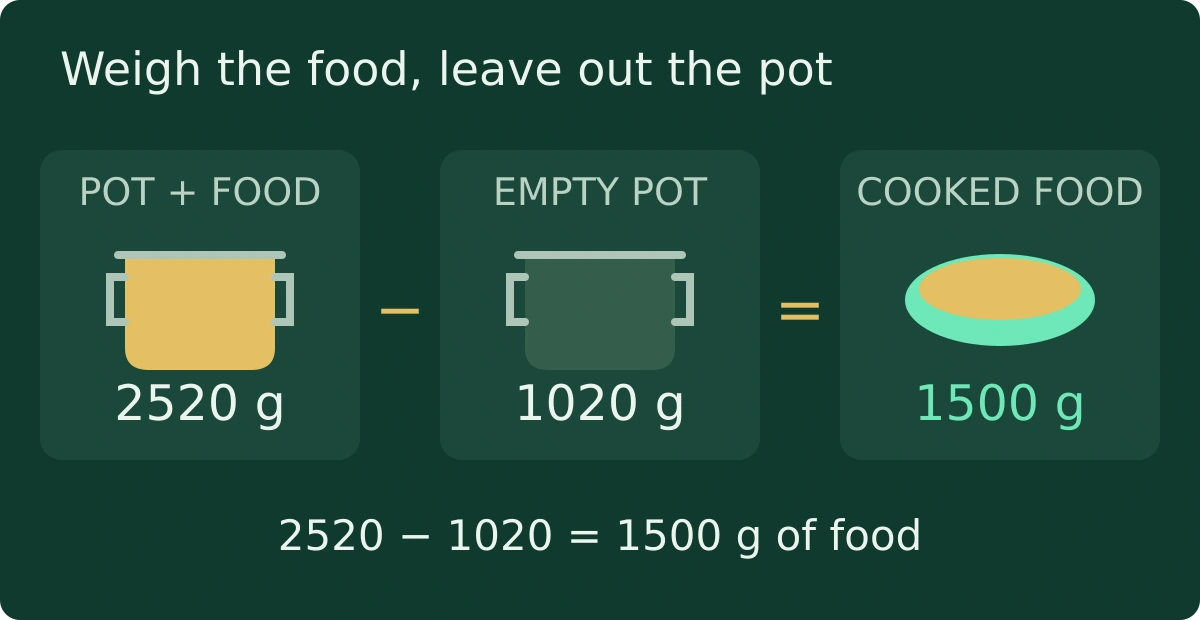
Write down the empty pot’s weight before cooking. Once the dish is ready, weigh the pot and food together and subtract:
Finished food = full pot − empty pot.
In our example, the empty pot is 1020 g and the full pot is 2520 g. That leaves 1500 g of cooked food.
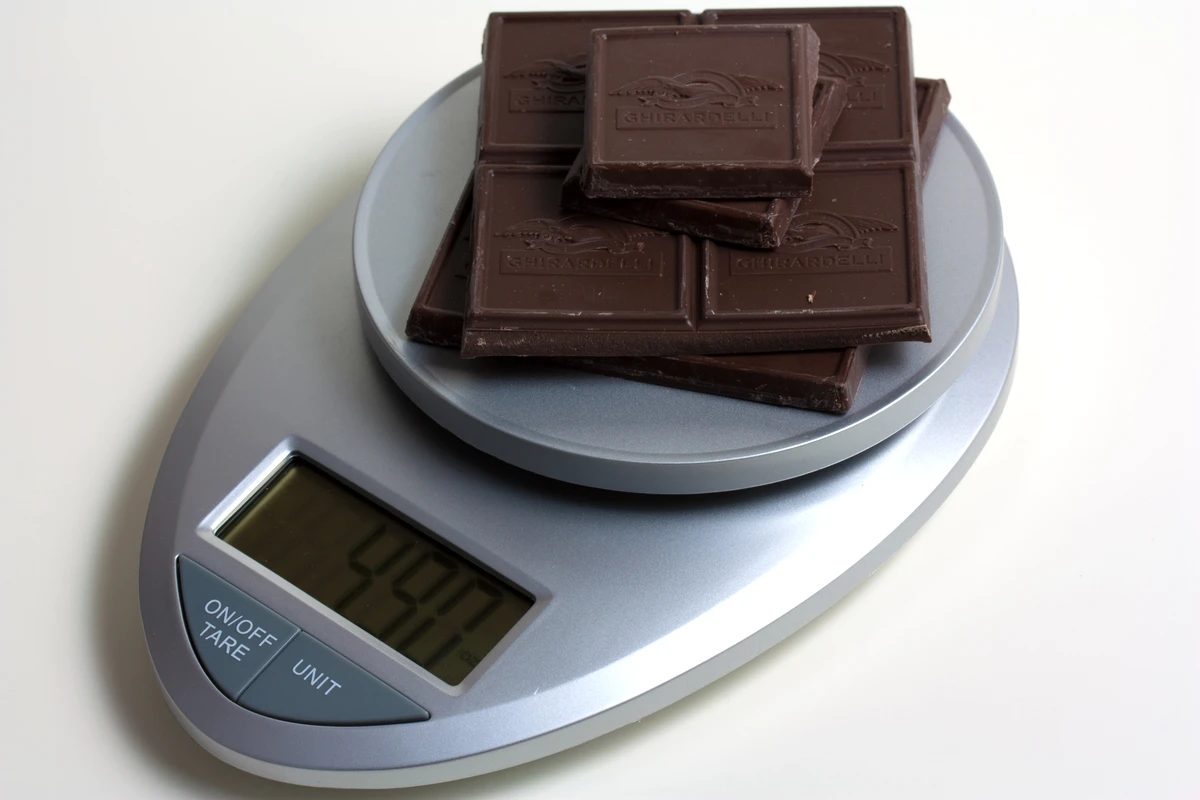
Or put an empty bowl on the scale, press tare to zero it, and transfer the food into that bowl. Check the scale’s capacity with the container included, and follow its instructions about heat. Don’t put a hot pan straight onto a scale that isn’t designed for it.

Why bother with the cooked weight? Pasta absorbs water, sauces simmer down, and meat can lose water and fat. The finished grams can be quite different from the ingredient weights. USDA’s cooking-yield research measures both moisture and fat changes.
For a batch where you keep all the ingredients, adding plain water or evaporating it changes the calories per 100 g without adding or removing calories from the batch. Pouring away fat, discarding sauce or leaving a substantial amount in the pan also removes food energy. We’ll come back to that.
4. Calculate the calories on your plate
Our 1425 kcal recipe weighs 1500 g. Divide the calories by the cooked weight and multiply by 100:
1425 ÷ 1500 × 100 = 95 kcal per 100 g.
Now weigh your portion. For 350 g:
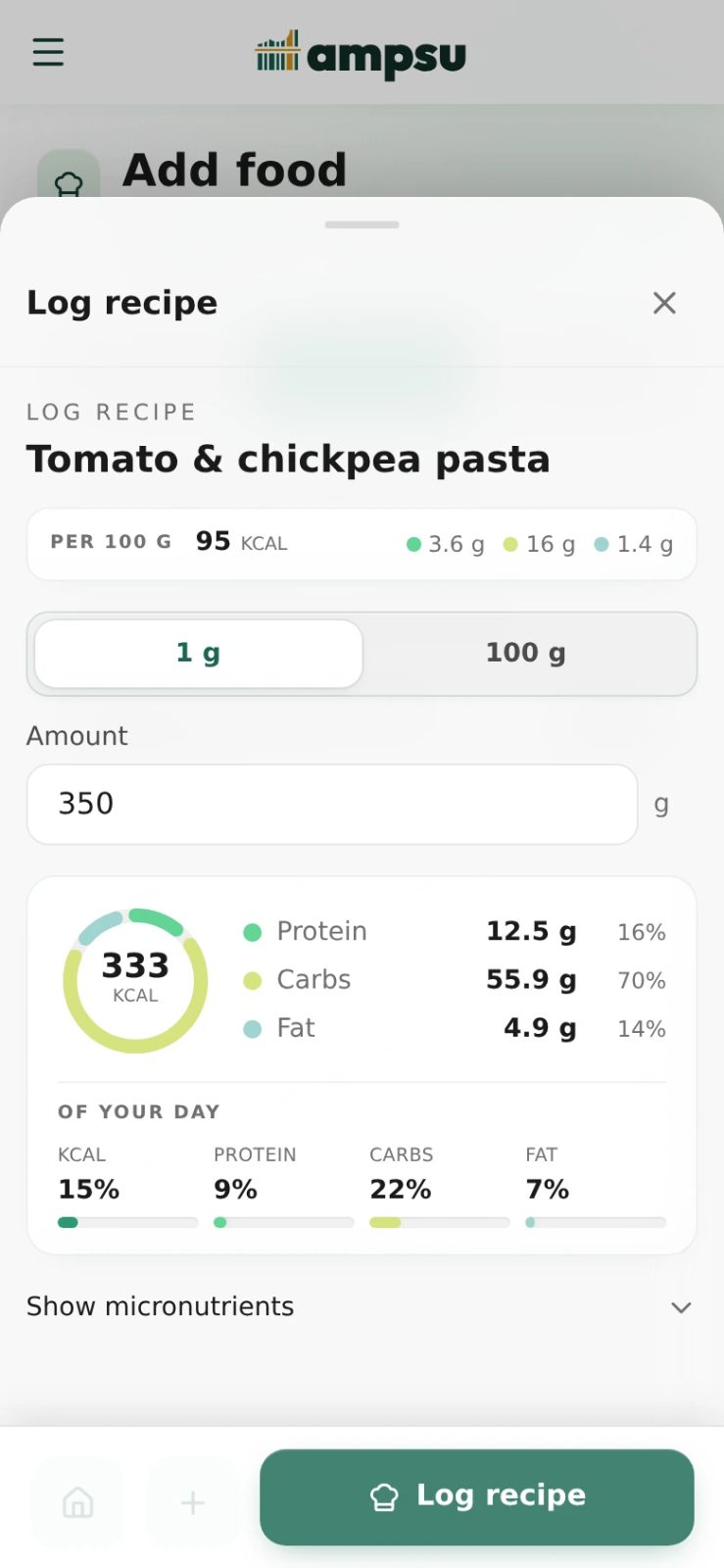
95 × 350 ÷ 100 = 332.5 kcal, or about 333 kcal.
This is why weighing the whole dish helps. If someone has a smaller plate and someone goes back for seconds, you can log each amount instead of deciding that everyone had “one serving”.
What if I split it into four equal portions?
Then divide 1425 by four: about 356 kcal each. With this cooked weight, four equal portions would be 375 g each. That’s a different amount from our 350 g plate, so it has a different calorie total.
If you’re portioning food into containers, put each container on the scale, tare it, and add your share. You can record equal portions without knowing the whole cooked weight if you really divide the entire recipe evenly. Knowing that weight is what lets you calculate arbitrary portions in grams.
This method assumes the mixture is reasonably even. Stir a sauce or stew before serving. If one plate gets most of the chickpeas and another gets mostly pasta, a weight-based average will be less representative. Separate components, such as chicken pieces beside rice, are often easier to log separately.
Save it once, then log the portion next time
The arithmetic is useful. Entering the same five ingredients every time you eat leftovers is less appealing.
In Ampsu, save the ingredients as a recipe and enter the finished weight. Here’s our example with its 1500 g cooked weight and 95 kcal per 100 g:
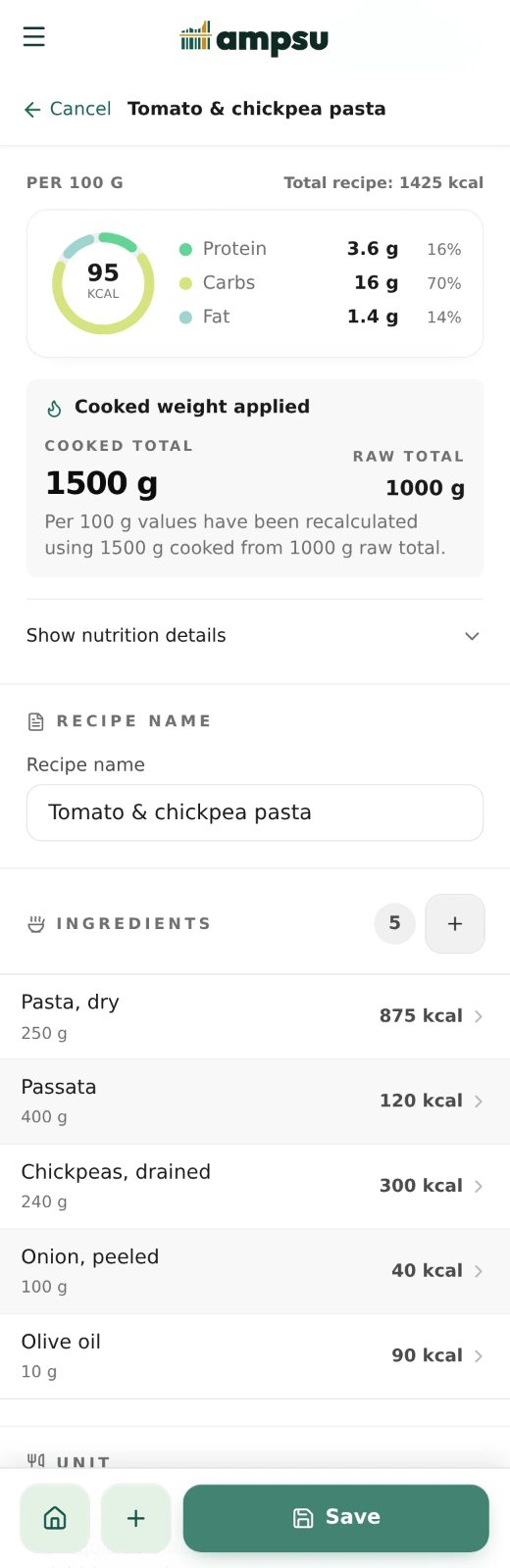
When you eat it, enter the amount on your plate. Our 350 g portion becomes about 333 kcal in the diary. You don’t need to enter the pasta, chickpeas, sauce, onion and oil separately again.
For the next batch, check what changed. Different ingredients, quantities or cooked weight change the calculation. Keep the saved recipe as a starting point, then update it to match what you’ve made.
Save a recipe in Ampsu if you’d like to keep the ingredients and finished weight together.
A few things that can throw the numbers off
I weighed it after cooking but used the dry-pasta calories
That mixes two different weights. For the whole-recipe method, record the dry ingredient amount and its matching nutrition value, then use the finished weight for dividing the recipe. You don’t also add the cooked pasta as another ingredient.
I used an “as prepared” label
Check the wording before adding milk, butter or other extras. Nutrition figures can describe the food as sold or, where preparation instructions are provided, the prepared food. The Food Safety Authority of Ireland explains this distinction. If the value already includes the milk specified on the packet and you add that same milk again, you count it twice.
I drained the fat or threw away a marinade
The ingredient sum assumes the counted food stays in the dish. If you discard some, that sum can overestimate what remains. A spoonful of pan liquid is a mixture of water, fat and other juices; its weight alone doesn’t tell you how many calories you removed. Use a matching cooked-and-drained food entry when one is available, or keep the uncertainty in your estimate. Don’t invent an exact fat deduction from the weight of the liquid.
I put cheese on my plate, not in the whole batch
Log that cheese with your portion. Adding it to the whole recipe would spread its calories across everybody’s plates. The same applies to a personal dollop of yoghurt, extra dressing or bread on the side.
I reheated the leftovers and they weigh less
They may have lost water. For a batch you’re eating over several meals, portioning and weighing it before storage avoids applying the original calorie-per-gram value to a noticeably drier reheated portion. If you reheat a known portion, keep its original recipe amount and record any extras you add.
Cool leftovers promptly and refrigerate within two hours; the Food Standards Agency’s leftovers guidance covers storage and reheating. Getting dinner weighed shouldn’t mean leaving a pot out all evening.
What if I forgot to weigh something?
You still have options. If you know all the ingredients and split the batch evenly, divide its total calories by the number of equal portions. If you forgot the empty pot, transfer the remaining food to a tared bowl before serving. If somebody has already eaten from it, that remaining weight is only the remaining food, not the original batch.
If the ingredient amounts are missing too, use the closest sensible meal estimate and move on. A generic “homemade pasta” entry won’t know how much oil or cheese you used, so treat it as approximate. The guide to tracking calories without weighing every cucumber covers making a food diary practical on those days.
Labels, ingredient databases and kitchen scales all have limits. The values on labels are averages, and a mixed meal won’t distribute perfectly onto every plate. Rounding our portion to 333 kcal is useful; treating the decimal as a laboratory result isn’t.
Try it with one meal you already cook regularly. Write down the empty pot’s weight, save the ingredients, weigh the finished food and log your portion. The next time that meal is dinner, you’ll have somewhere sensible to start.