What does creatine do? Benefits, dose and when to take it
Creatine helps muscles in short, hard efforts and adds a little muscle with training. What it does, how much to take, loading, timing and which form to buy.
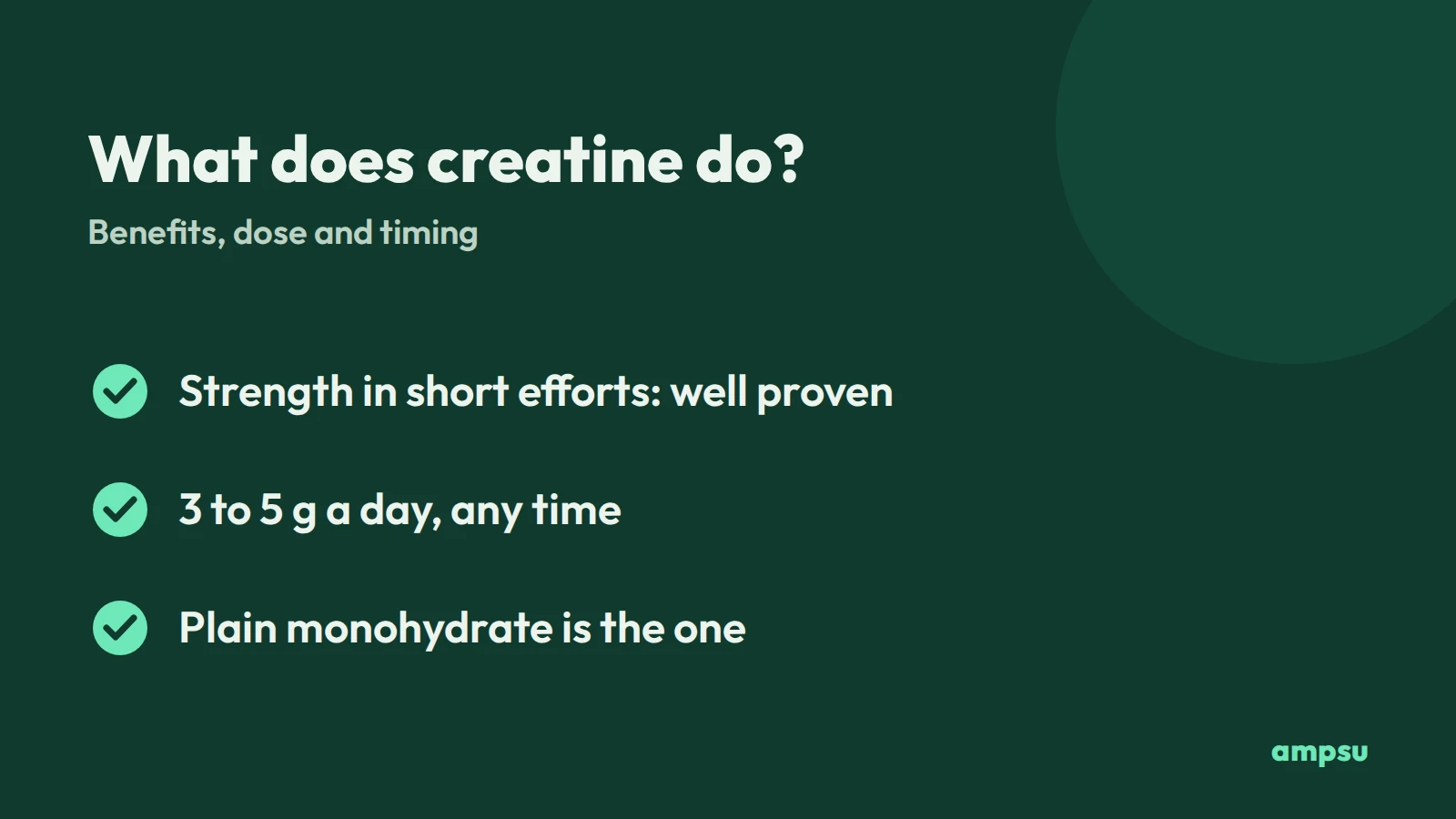
Creatine helps your muscles refill their fastest energy supply, the one you use for a heavy set, a sprint or a jump. Taken every day alongside strength training, it adds a little more strength and muscle than training alone. The usual dose is 3 to 5 g of creatine monohydrate a day, at any time of day, and it's one of the most studied supplements there is.
It isn't a steroid, it doesn't burn fat, and it works slowly. Here's what it actually does, what it doesn't, and how to take it without overthinking it.
What is creatine?
It's a compound your body makes itself from three amino acids, mostly in the liver and kidneys, and that you also get from meat and fish. The International Society of Sports Nutrition's position stand puts the daily need at 1 to 3 g, about half of it from food: 450 g of raw beef or salmon has 1 to 2 g. Vegetarians and vegans tend to have lower stores, so they often see more of an effect from supplementing.
Most of your creatine sits in muscle as phosphocreatine, a quick backup that rebuilds ATP, the molecule muscles spend for energy, during the first seconds of a hard effort. Fuller stores mean a slightly better last rep or a slightly faster sprint, and over months of training those small margins add up.
What does creatine do?
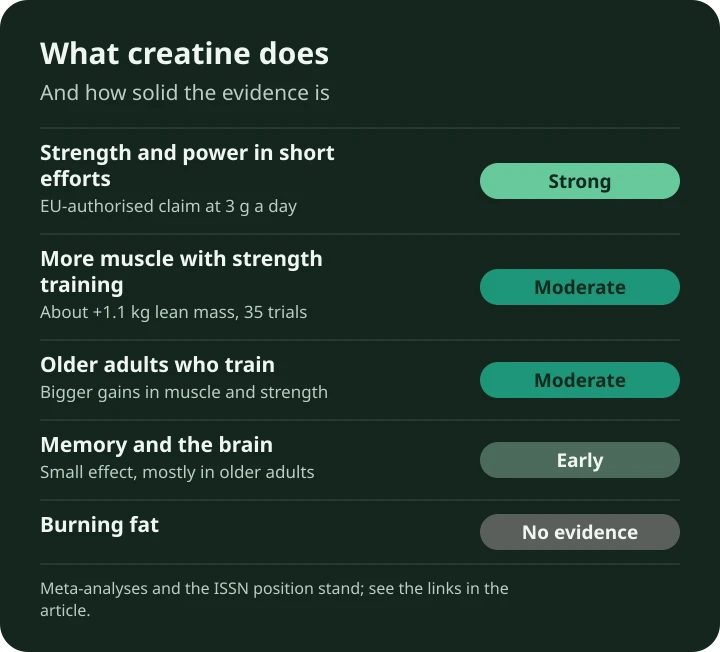
- More strength and power in short efforts. This is the part with the strongest evidence. The EU allows products providing 3 g a day to claim that creatine increases physical performance in successive bursts of short-term, high-intensity exercise.
- A bit more muscle when you train. In a 2022 meta-analysis of 35 trials, creatine plus strength training added about 1.1 kg of lean mass compared with training alone. Without training it made no measurable difference. Part of that lean mass is extra water inside the muscle, which is normal.
- Older adults keep up better. A meta-analysis of trials in older adults found creatine increased the gains in muscle and strength from resistance training.
- The brain, possibly. A 2022 meta-analysis found a small improvement in memory, mostly in people aged 66 to 76, and a 2024 study found that one large dose softened the mental slump of a sleepless night. Interesting, early, and not a reason to take it on its own.
What it won't do is burn fat, or build muscle you aren't training.
How much creatine should I take?
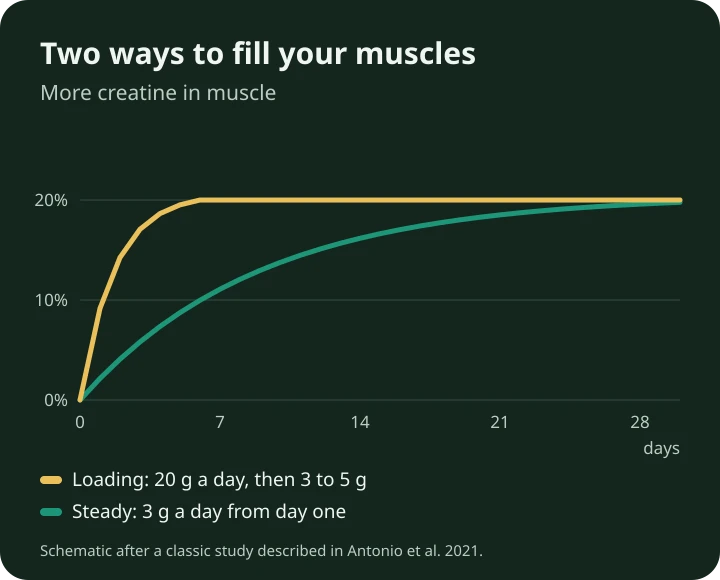
The standard dose is 3 to 5 g a day of creatine monohydrate. You can start with a loading phase, about 20 g a day split into four doses for 5 to 7 days, then drop to 3 to 5 g. Or you can take 3 to 5 g from day one and skip the loading.
Both get you to the same place. A review of common creatine questions describes a classic study in which 3 g a day for 28 days filled the muscles as much as 20 g a day for 6 days. Loading gets you there in a week. It's also more likely to upset your stomach and bump the scale, so unless you have a competition coming up, the slow route is the comfortable one.
When should I take creatine?
Whenever you'll remember. Creatine builds up in muscle over weeks, so the time of day barely matters and taking it every day matters a lot. With breakfast, or in a post-workout shake, is easy. It doesn't dissolve well in cold water, so stir properly, or mix it into something warm like tea or porridge.
Which type of creatine is best?
Plain creatine monohydrate. Almost all the research used it, it's cheap, and the review above found no evidence that other forms work better. "Creapure" on a label is a brand of monohydrate made in Germany, not a different kind of creatine. Ready-made creatine drinks are rare because creatine doesn't stay stable in liquid for long.
Does creatine have calories?
Practically none at 3 to 5 g, so it won't move your calorie count. What can move is the scale. If you load, expect around 0.5 to 1 kg more in the first week, which the ISSN describes as water retention roughly matching the weight gained. This article on creatine side effects and weight gain covers that, plus the hair and kidney questions.
How Ampsu fits in
Creatine works with enough protein and regular strength training, and those are the parts worth tracking. Ampsu's diary shows protein for every meal, and the protein calculator gives you a target to aim for. If you start creatine during a diet, keep logging your weight as usual and remember the start date, so the first week's water doesn't look like a sudden stall. Creatine for women looks at what's different for women.
Your first step
If you want to try it, buy plain creatine monohydrate and take 3 to 5 g with breakfast every day for a month. After four weeks, judge it by your training log rather than the mirror.