How to count macros: a beginner's guide with real numbers
Macros are protein, carbs and fat. How many grams you need a day, a worked example for 1,800 kcal, how to count them without doing maths, and whether you need to count all three.
Somebody at the gym says they "hit their macros" every day, and it sounds like a club with a secret handshake. It's simpler than that. Macros are the three things food is made of that give you energy: protein, carbs and fat. Counting them means keeping a rough tally of grams of each, on top of (or instead of) counting calories.
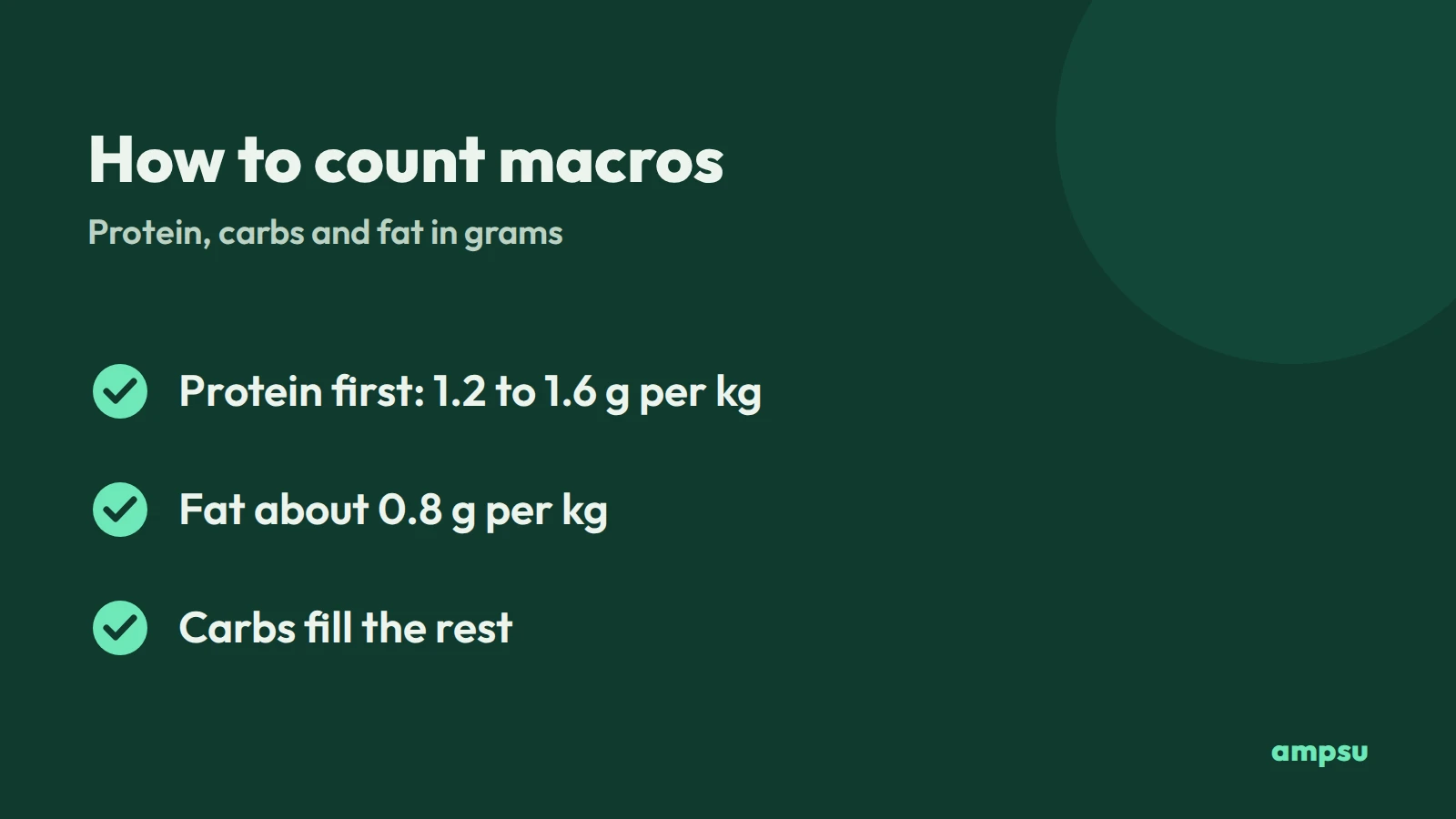
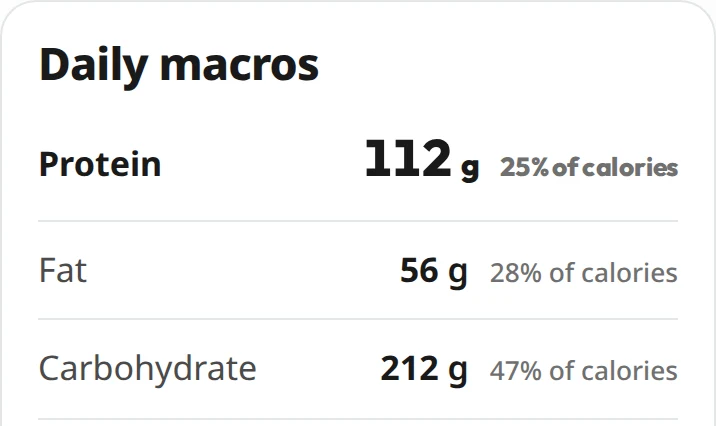
The short version: set protein first, at about 1.2 to 1.6 g per kg of body weight, give fat around 0.8 g per kg, and let carbs fill whatever calories are left. For a 70 kg person eating 1,800 kcal, that's roughly 112 g of protein, 56 g of fat and 212 g of carbs. Then log what you eat and aim to come within about 10 g of protein and carbs and 5 g of fat, most days.
Here's where those numbers come from, how to count them without a calculator in your head, and whether you need to count all three at all.
What are macros, and how many calories are in each?
Every gram of protein and every gram of carbohydrate gives you about 4 kcal. A gram of fat gives 9. Alcohol, the unofficial fourth macro, gives 7. Those are the factors EU food labels are calculated with, so the kcal on a packet is basically the macros multiplied out (plus 2 kcal per gram of fibre, if you were wondering why the sum is sometimes a little off).
That's why fat looks so expensive in calories, and why two foods with the same calories can feel completely different. 30 g of butter and 125 g of cooked chicken breast are both a little over 200 kcal. Only one of them is lunch.
How many macros do I need a day?
Start with your calorie target, then split it in this order:
- Protein first. Around 1.2 to 1.6 g per kg of body weight suits most people who are losing weight or training. Going above about 1.6 g didn't add more muscle in a review of 49 trials, so there's no need to force down more. If you carry a lot of extra weight, base it on a goal weight instead, or the number gets silly.
- Fat next. About 0.8 g per kg is a comfortable middle. EFSA's reference range for adults is 20 to 35% of your calories from fat, and very low-fat diets tend to be hard to stick to anyway.
- Carbs get the rest. Whatever calories are left after protein and fat. For most people that falls within EFSA's 45 to 60% range for carbs without trying.
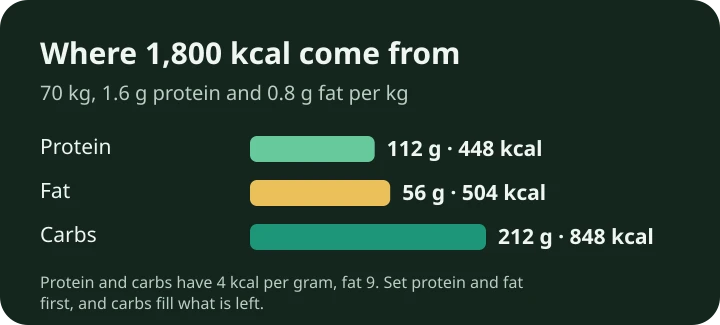
The macro calculator does this split for you, by grams per kilo, by percentages or with grams you choose yourself. It also shows what that means per meal.
How do you actually count macros?
Nobody adds up grams of fat on a napkin. In practice it goes like this:
- Log what you eat in an app. Scan the barcode or search for the food, enter the weight, and the app works out all three macros from the label. Your job is the logging, the app's job is the maths.
- Weigh the foods that swing it. Oil, nut butter, cheese, rice and pasta are where guesses go wrong. A salad leaf here or there doesn't matter.
- Read the label per 100 g. EU labels always give values per 100 g, which makes comparing two yoghurts in the shop easy: more protein, less sugar, done.
- Look at the day around dinner. If protein is short, dinner is your chance to fix it. If carbs ran high at lunch, a lighter dinner on the carb side balances it.
Aim for close, not exact. Within about 10 g of protein and carbs and 5 g of fat is a good day. Food labels themselves can be off by more than that, so there's little point chasing the last gram.
Do I need to count all three?
For most people, no. If your goal is losing weight, calories decide whether you lose, and protein decides how much of the loss is fat rather than muscle. Counting those two gets you almost everything. Carbs and fat can sort themselves out within your calories, and plenty of people eat well that way for years.
Full macro counting earns its keep if you train seriously, if you want to see how your diet is actually built, or if you've plateaued and want more detail to look at. It's also a good way to learn: a few weeks of seeing the numbers teaches you which foods carry protein and which ones are mostly fat (peanut butter is not a protein food, sorry).
How Ampsu helps
Ampsu shows protein, carbs and fat for every food and every meal, next to the calories, and lets you set targets for each. Scan a barcode or snap a label and the macros come straight from the packet. If you only care about calories and protein, you can leave the rest in the background and it'll still be there if you get curious later.
Your first step
Put your calorie target into the macro calculator, write down the protein number, and for the next week only worry about that one. Once protein comes easily, the other two are a much smaller step.