How many calories should I eat a day? Men and women by age
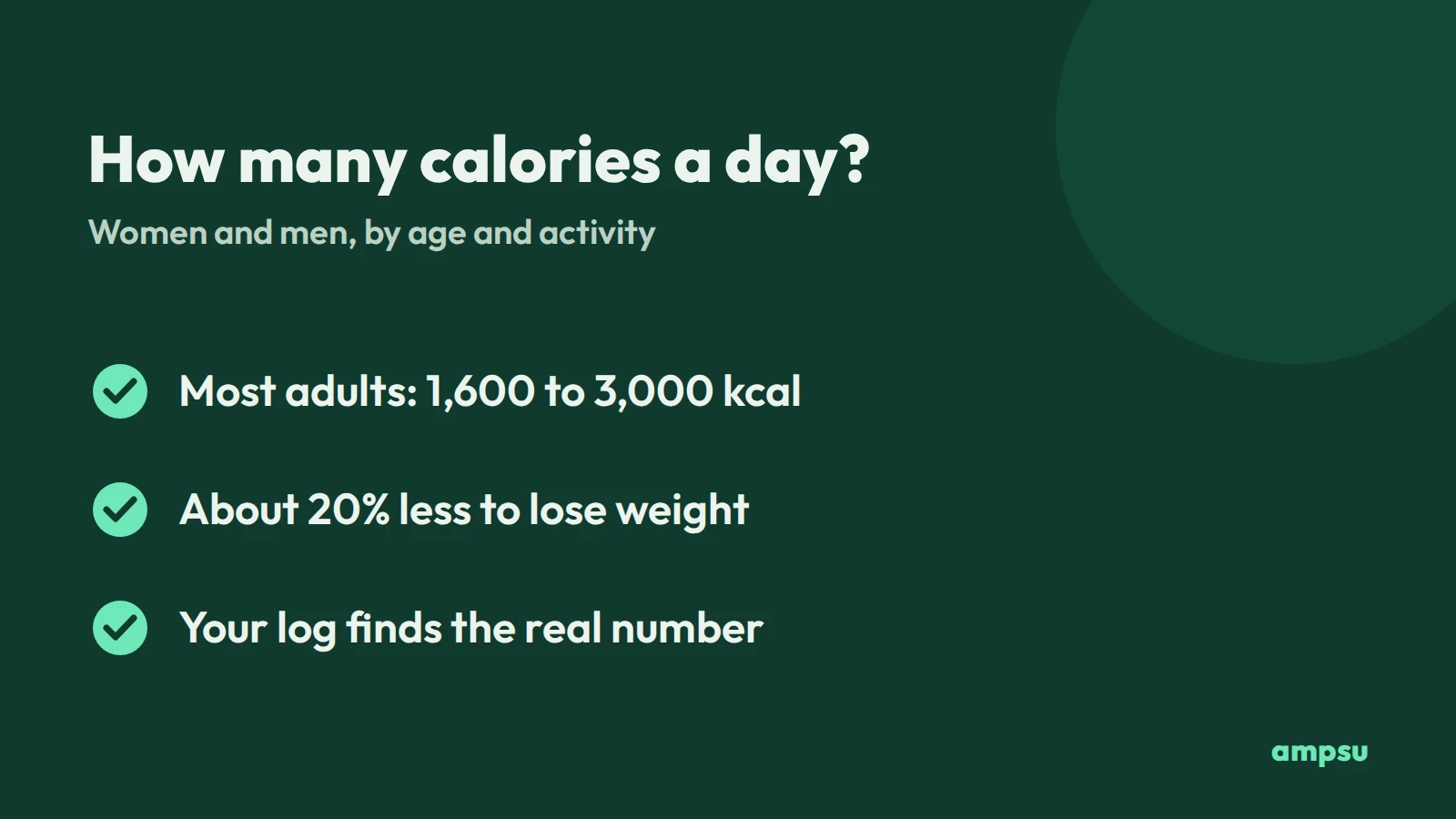
Most adults burn 1,600 to 3,000 kcal a day. Tables for women and men by age and activity, what to eat to lose or gain weight, and how to find your own number.
The back of a cereal box says 2,000 kcal. Your gym friend eats 3,000 and stays lean, and the plan a colleague printed out says 1,500 for everyone, apparently including people who are 190 cm tall. So how many calories should you actually eat in a day?
Most adults burn somewhere between 1,600 and 3,000 kcal a day. For a woman of average height that's usually 1,600 to 2,200, and for a man 2,000 to 2,800, with very active people above that. Your height, your weight and how much you move decide where you sit in that range. To lose weight, eat about 20% less than your number. To gain, eat about 250 to 500 kcal more.
Below are tables for women and men by age, what moves the number most, and how to swap a calculator's guess for your own figure.
Where does the 2,000 kcal on labels come from?
It's a label convention. EU food labels show percentages against a reference intake of 2,000 kcal for an average adult, so that "12% of your daily intake" means something. The NHS uses 2,000 for women and 2,500 for men as rough averages for keeping a healthy weight.
That's fine on a yoghurt pot. As a target for one person it's a coin toss, because a 155 cm woman with a desk job and a 190 cm man who works on a building site can be well over 1,000 kcal a day apart.
How many calories a day for a woman?
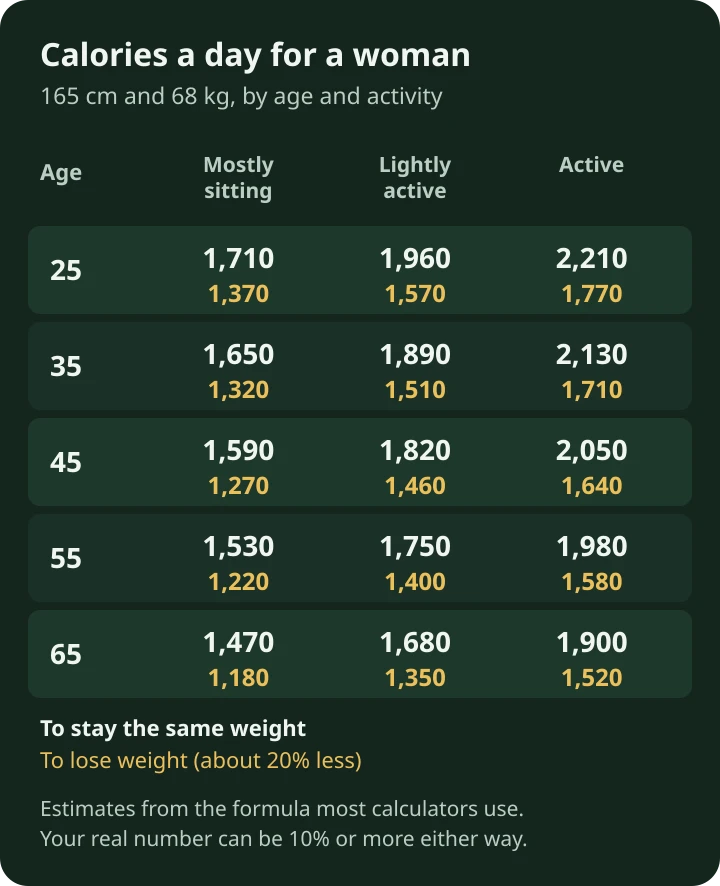
There's a longer piece on how many calories a woman should eat, including what changes for smaller women and whether 1,200 kcal makes sense.
How many calories a day for a man?
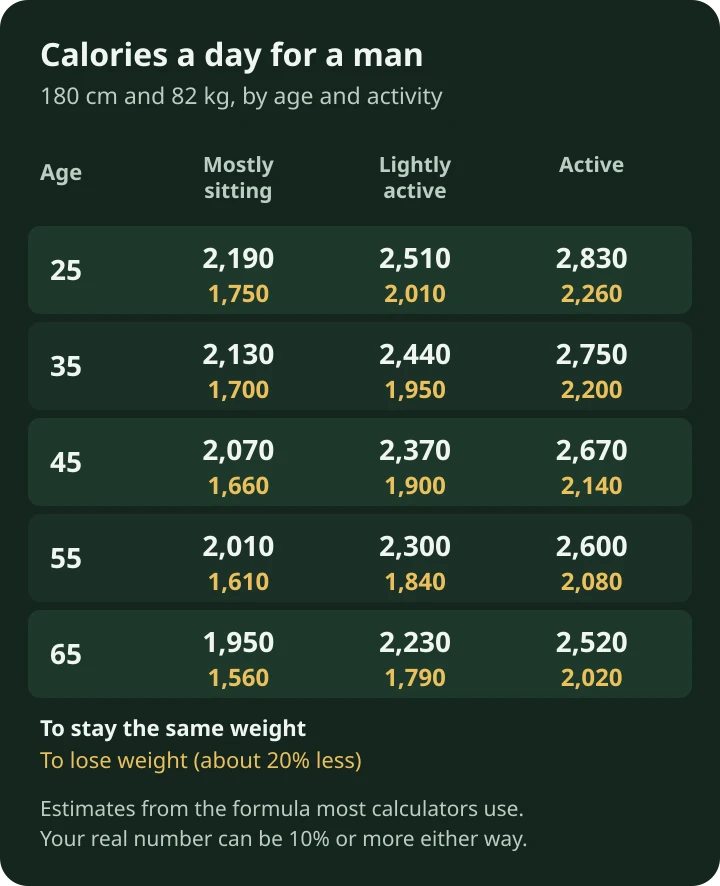
Men come out higher mostly because they're bigger and carry more muscle on average. The formula gives a man 166 kcal more resting burn than a woman of the same height, weight and age, and the rest of the gap between the two tables is size.
"Mostly sitting" is an office job and not much else. "Lightly active" means a couple of workouts a week or a job on your feet, and "active" is regular training on top of a busy day. People tend to pick one level higher than they really are (the activity dropdown is a born optimist), so if you're torn between two, take the lower one.
What changes your number the most?
Size and movement, by a distance. Going from mostly sitting to active adds about 30% in the formula. Ten extra kilos of body weight add roughly 100 kcal of resting burn, which works out at 120 to 155 kcal a day once activity is counted.
Age matters less than most people think. The formula takes 5 kcal a day off resting burn for every year, which comes to 60 to 80 kcal per decade once activity is counted. And a large study that measured thousands of people found that for the same amount of lean tissue, daily burn holds steady from about 20 to 60. What usually changes over the years is muscle and how much you move, and you can do something about both.
How many calories should I eat to lose weight?
Start about 20% under your maintenance. For the 35-year-old man in the table who's lightly active, that's around 1,950 kcal instead of 2,440. For the woman of the same age it's about 1,510 instead of 1,890. After the first week or two, when water makes the scale jumpy, expect something like 0.3 to 0.5 kg a week.
A kilo of body fat holds roughly 7,700 kcal, which is where that arithmetic comes from, although the curve flattens as you go. Ampsu's calculators don't go below 1,200 kcal. If a lower number seems right for you, talk it through with a doctor first.
And to gain weight?
Eat 250 to 500 kcal over maintenance. The smaller surplus suits you if you're lifting and want most of the gain to be muscle, the bigger one if you're underweight or the kind of person who forgets lunch until four. Weigh yourself a few times a week and adjust if the weekly average climbs faster than you wanted.
What about teenagers?
The tables are for adults. Teenagers are still growing, so they can need more than an adult of the same size, and the number moves as they grow. That's why Ampsu's calorie calculators start at 18. For someone younger, the children's BMI calculator shows whether weight is keeping pace with height, and a GP or school nurse is the right person to ask about calories.
How do I find my real number?
Everything above is an estimate. The most reliable of the common formulas comes within 10% of measured resting burn for most people, which still leaves a few hundred kcal of slack either way. Your own food log and weight trend close that gap:
- Eat roughly your estimate for three or four weeks and log it. Roughly is fine.
- Weigh yourself a few times a week and compare weekly averages, not single mornings.
- If the average held steady, that's your maintenance. If it moved, every kilo over four weeks means about 275 kcal a day of difference.
The piece on maintenance calories goes through this in more detail. In the app, Ampsu does the same sums in the background from your log and weigh-ins, and moves your target when your burn changes.
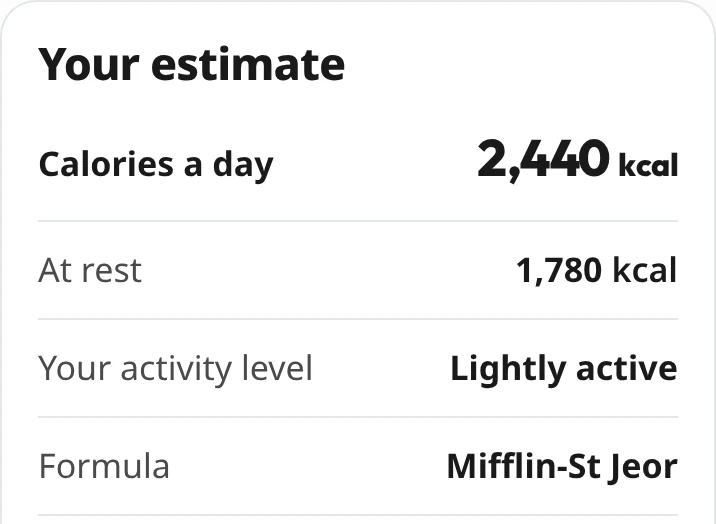
Your first step
Put your own numbers into the daily calorie calculator, take the lower activity level if you're unsure, and eat close to the result for three weeks before you decide whether it fits.