How many calories should a woman eat a day to lose weight?
Most women burn about 1,600 to 2,400 kcal a day. Tables by age and activity, how much size changes it, and how many calories to eat to lose weight.
Every food label says 2,000 kcal. Half the diet plans online say 1,200. A friend's app gave her 1,500, and the one you tried last year said 1,800. So how many calories should a woman actually eat in a day?
Most adult women burn somewhere between about 1,600 and 2,400 kcal a day. Where you land depends mostly on your height, your weight and how much you move, and less on your age than people think. To lose weight, eat about 20% less than your own number, which for many women means somewhere between 1,300 and 1,900 kcal.
Below are the numbers by age and activity, how much your size shifts them, and how to turn a calculator's guess into a number that's actually yours.
Where does the 2,000 calories on labels come from?
It's a reference value, chosen so that percentages on packets mean something. EU food labels use a "reference intake of an average adult" of 2,000 kcal. The NHS uses 2,000 for women and 2,500 for men as averages for staying at a healthy weight.
An average is fine for a label. It's less useful for a person, because a 155 cm woman who works at a desk and a 175 cm woman who cycles to work can be 600 kcal apart.
How many calories does a woman need a day?
Here's what the most widely used formula estimates for a woman who is 165 cm and 68 kg, at different ages and activity levels:
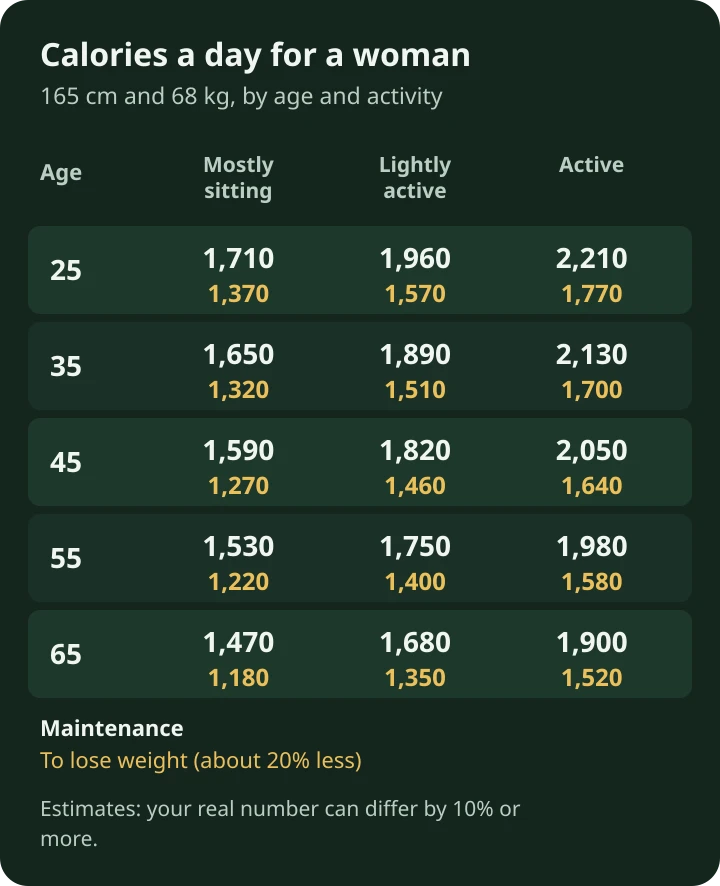
"Mostly sitting" means an office job and not much else. "Lightly active" is a couple of workouts a week or a job on your feet. "Active" is regular training plus a fairly active day. Most people overestimate their activity, so if you're unsure, pick the lower one.
The formula, called Mifflin-St Jeor, isn't magic. A systematic review found it the most reliable of the common equations, landing within 10% of measured resting burn for more people than any other, and also that it can still be off by more than that for some individuals. Treat the table as a starting point.
How much do height and weight change it?
A lot more than age. Here are five women of the same age and activity level:
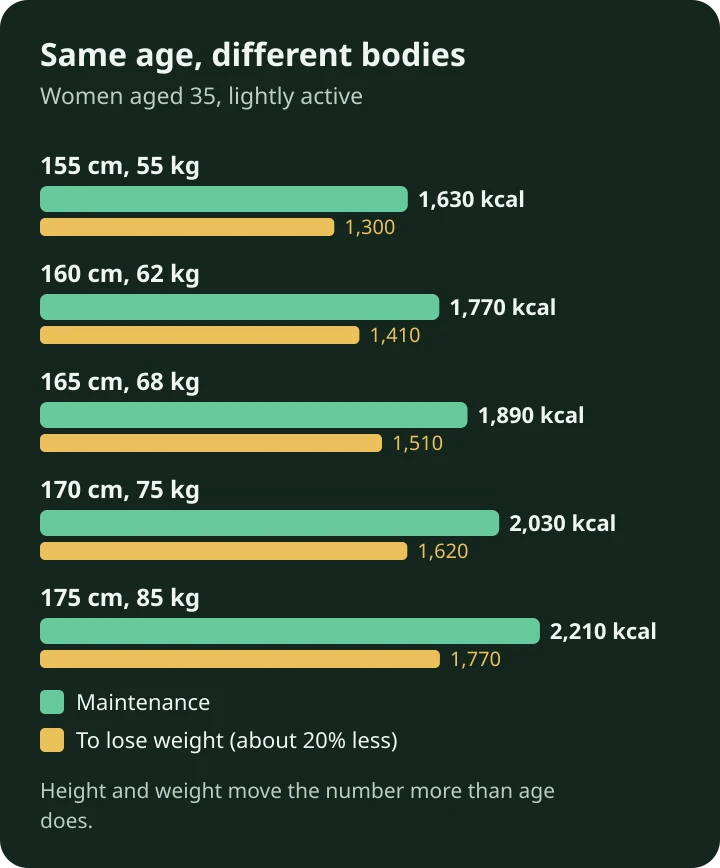
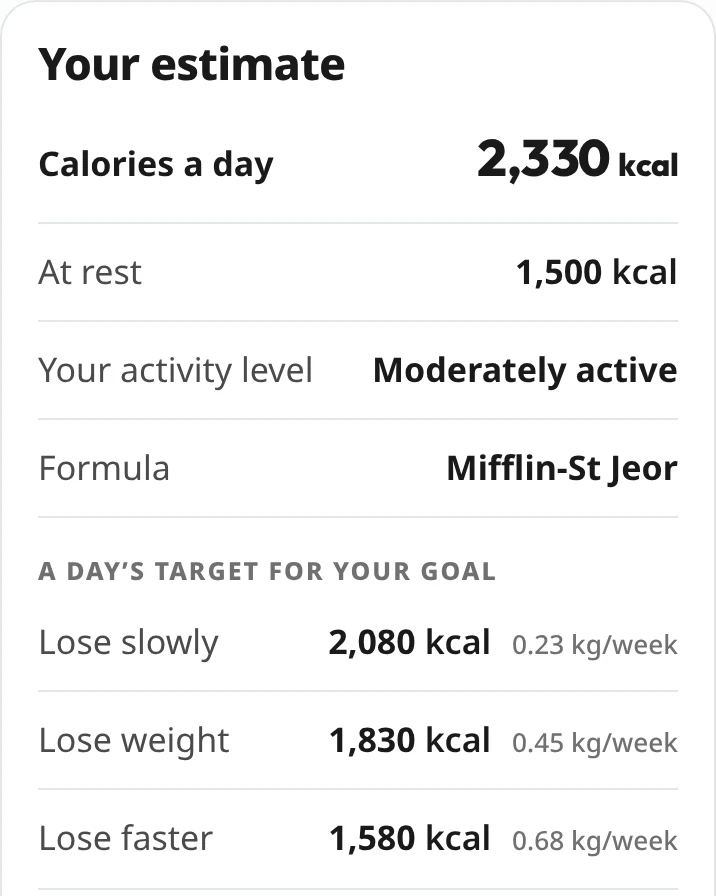
That's why a single number for "women" doesn't work. If you want your own estimate, the daily calorie calculator takes your height, weight, age and activity and also shows targets for losing weight at three different paces.
How many calories should I eat to lose weight?
About 20% under your maintenance is a good start. For the woman in the table, aged 35 and lightly active, that's around 1,500 kcal instead of 1,890. Expect something like 0.3 to 0.5 kg a week after the first couple of weeks, when water makes the scale jumpy.
Smaller women have less room, which is part of why the same diet plan feels easy to one person and miserable to another. A 155 cm, 55 kg woman who sits most of the day burns about 1,420 kcal, so even a modest 20% cut takes her to around 1,140. That's already low, and a slower pace with more walking is often easier than cutting further.
If you want the detail on picking the size of the cut, this explainer on calorie deficits goes through it, including why 500 kcal a day doesn't quite mean half a kilo a week.
Does your metabolism slow down with age?
Less than you'd think. The formula takes off 5 kcal a day for every year of age, which is why the numbers in the table drift down. But a large study of thousands of people measured with the gold-standard method found that, for the same amount of muscle and other lean tissue, daily burn stays remarkably steady from about 20 to 60, even through pregnancy, and only declines after that.
So what usually changes with age is the body around the metabolism: a bit less muscle and a bit less moving around. Both of those you can do something about, which is better news than "it's your metabolism".
Is 1,200 calories enough?
For some women it's a reasonable weight-loss target, for most it's a steep one. In the table above, 1,200 is roughly where a 65-year-old who sits most of the day would land with a 20% cut. For a 35-year-old who's moderately active, 1,200 would be a cut of more than 40%, which is hard to keep up and hard to get enough protein from.
That's also why Ampsu's calculators don't go below 1,200 kcal. If a target lower than that seems right for you, talk it through with a doctor first. The same goes if you're pregnant or breastfeeding, when your needs go up rather than down.
How do I find my real number?
The table and the calculator are both estimates. Your own food log and weight trend are what tell you the truth.
- Start from your estimate and eat roughly that for three or four weeks, logging as you go.
- Weigh yourself a few times a week and look at the weekly average, not single days.
- If your weight held steady, your maintenance is about what you ate. If it moved, the difference tells you how far off the estimate was.
The TDEE-from-your-log calculator does that maths for you from a few weeks of numbers. In the app, Ampsu keeps doing it in the background and adjusts your target as your burn changes.
Your first step
Get your estimate from the daily calorie calculator, pick the lower activity level if you're torn, and give it three weeks of rough logging before deciding whether the number fits.