Maintenance calories: how to find your real number
Maintenance calories keep your weight stable. Calculators get within about 10% for most people; here's how to find your real number with a few weeks of logging.
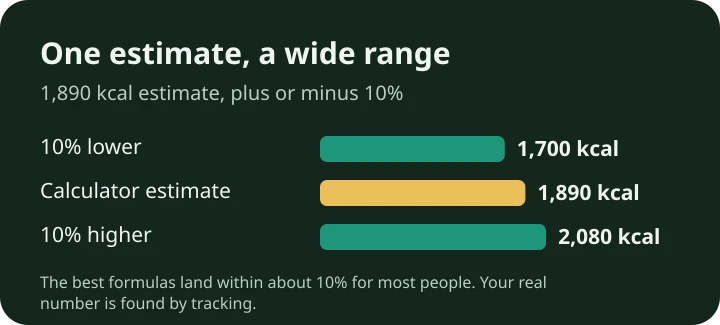
Maintenance calories are the number of calories you can eat in a day without gaining or losing weight. A calculator gives you a starting estimate in seconds, but even the best formula is only within about 10% for most people, which can be a few hundred kcal either way. The way to find your real number is to eat consistently, log it, weigh yourself, and let a few weeks of data tell you.
It's the most useful number in nutrition and the one people guess at most. Here's how to stop guessing.
What are maintenance calories?
Your maintenance is your total daily energy expenditure, often shortened to TDEE. It's made of the energy you burn at rest just keeping the lights on, the energy you use digesting food, and everything you do while moving, from workouts to walking to the kettle. Eat that amount and your weight stays roughly flat over weeks. Eat less and you lose; eat more and you gain.
How to calculate maintenance calories
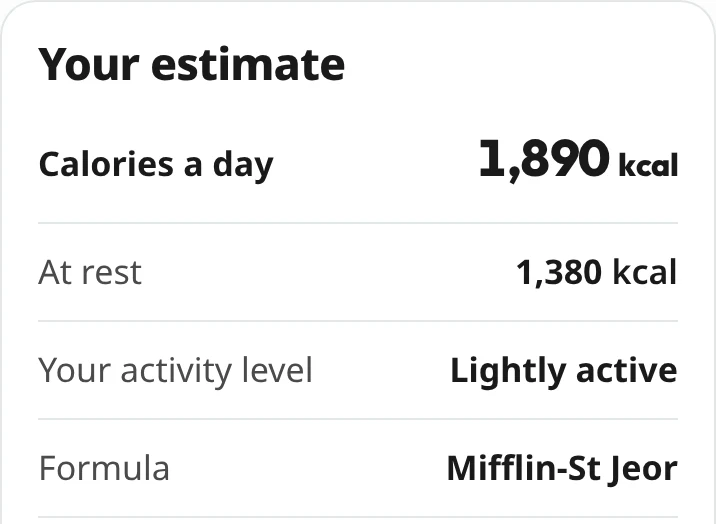
Calculators start with your resting burn, estimated from your sex, age, height and weight, and multiply it by an activity factor. A systematic review of the common formulas found the Mifflin-St Jeor equation was the most reliable, predicting resting burn within 10% of measured in more people than any other. That's why Ampsu's calorie needs calculator uses it.
But "within 10% for most people" also means some people are further off, and the activity factor adds its own guesswork. Nobody quite knows whether their life counts as "lightly" or "moderately" active.
How to find your real maintenance
Use the estimate as a starting point, then test it. Eat around that number for two to four weeks, log what you eat as honestly as you can, and weigh yourself several times a week. Then:
- If your average weight didn't change, you've found maintenance.
- If it went down, your maintenance is higher than what you ate. Every 1 kg lost over four weeks means roughly 275 kcal a day more.
- If it went up, your maintenance is lower by the same logic.
Use weekly averages, not single weigh-ins. Water, salt and the timing of your last meal easily move the scale by a kilo from one morning to the next. The actual burn calculator does the arithmetic if you give it your average intake and two weights.
What changes your maintenance?
Your maintenance isn't fixed. It drops as you lose weight, because a smaller body burns less, and often drops a little more than that after a diet. It rises with more steps, more training and more muscle. It falls slowly with age, mostly because people tend to move less and carry less muscle. So the number you found last spring might not be the number you have today, especially after a weight change. If you've just finished a diet, this guide to coming off a diet covers what to expect.
How Ampsu finds your maintenance
Ampsu does the "eat, log, weigh, adjust" loop for you. It compares what you log with how your weight trend actually moves and works out what you really burn, updating as your weight, activity and habits change. That's your maintenance based on you, not on a formula built from other people's averages. The calculator gets you started on day one; a few weeks of logging gets you the real thing.
Your first step
Get an estimate from the calculator, then eat close to it for the next two weeks and weigh yourself every couple of days. At the end, compare your average weight from week one and week two. The difference tells you which way to adjust.