How much protein per day? Grams for your weight and goal
Most adults need about 0.8 g of protein per kg a day, but losing weight, training or being over 65 changes that. A table by weight, and 100 g as food.
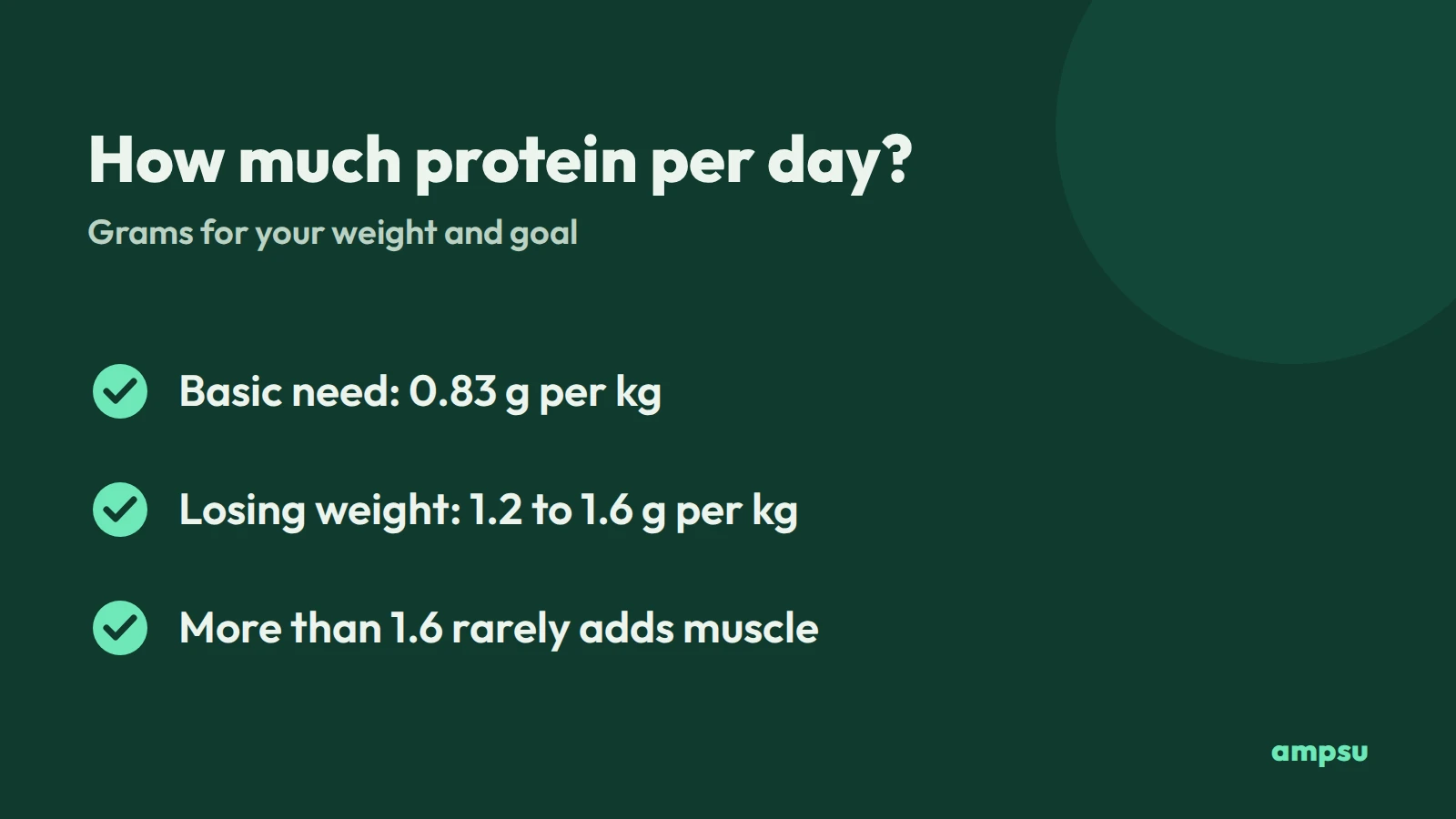
The basic answer is about 0.83 g of protein per kg of body weight a day, the European reference for healthy adults. If you weigh 70 kg, that's 58 g. But that figure is a floor for not running short. It was never meant for someone losing weight, lifting or over 65, and for them most research lands between 1.0 and 1.6 g per kg.
So the useful question is which group you're in. Here's how to find your number, what it looks like as food, and the point where more stops helping.
How much protein do I need a day?
Multiply your weight in kg by the figure for your situation:
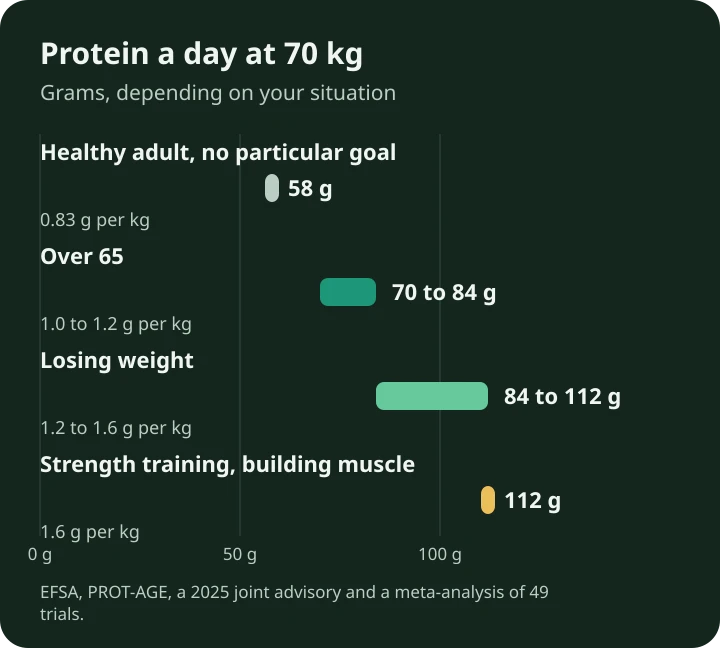
- Most adults, no particular goal: 0.83 g per kg. This is EFSA's population reference intake, set to cover the needs of almost everyone.
- Over 65: 1.0 to 1.2 g per kg. Muscle gets harder to keep with age, and an expert group on older adults recommends at least this much, and more for people who are active or ill.
- Losing weight: 1.2 to 1.6 g per kg, to hold on to muscle while you eat less. That range comes from a 2025 advisory by four obesity and nutrition societies.
- Strength training to build muscle: about 1.6 g per kg. In a meta-analysis of 49 trials, extra protein stopped adding muscle beyond roughly 1.6 g per kg.
| Your weight | No particular goal | Over 65 | Losing weight | Building muscle |
|---|---|---|---|---|
| 60 kg | 50 g | 60 to 72 g | 72 to 96 g | 96 g |
| 70 kg | 58 g | 70 to 84 g | 84 to 112 g | 112 g |
| 80 kg | 66 g | 80 to 96 g | 96 to 128 g | 128 g |
| 90 kg | 75 g | 90 to 108 g | 108 to 144 g | 144 g |
If you're carrying a lot of extra weight, multiplying by your full weight overshoots, because body fat needs very little protein. The same advisory points this out. Using your goal weight instead gives a more sensible number.
What does 100 g of protein look like?
More food than most people expect, unless protein is the main thing on every plate. Here's a rough day:
- 200 g of skyr at breakfast: about 22 g
- 2 boiled eggs: about 13 g
- 100 g of cooked chicken breast at lunch: about 31 g
- 150 g of cooked lentils at dinner: about 14 g
- 2 slices of rye bread, a slice of cheese and a glass of milk: about 17 g between them
That comes to about 97 g, without a single shake. Take the chicken away and the day drops to the mid-60s, which is how people usually end up short: one meal with no real protein in it, very often breakfast. This comparison of high-protein foods shows which supermarket picks give you the most per calorie.
Is it better to spread protein over the day?
For most people, yes, though not for the reason you've probably heard. The old line that your body can only use 25 to 30 g at a time doesn't hold up. In a 2023 study, 100 g of protein after exercise kept muscle building going for more than 12 hours, longer and stronger than 25 g did.
The practical reason to spread it is fullness. Twenty-five to 35 g at each of three meals is easier to eat than 90 g at dinner, and a breakfast with real protein in it tends to keep you away from the biscuit tin at eleven.
Can you eat too much protein?
Not easily, if your kidneys are healthy. EFSA considers intakes up to about twice the reference, roughly 1.7 g per kg, safe for adults. Above that there's little evidence either way, and rarely a reason to go there. If you have kidney disease, the rules are different, so follow your doctor's advice.
The more common cost is a boring one. Protein foods tend to be pricier, and a day built around 2.5 g per kg leaves less room for vegetables, grains and fibre, which matter too.
Does protein help with weight loss?
In two ways. It's the most filling of the three macronutrients, so the same calories keep you satisfied for longer. And it helps you keep muscle while you're in a deficit. In a four-week study of young men on a steep calorie deficit with hard training, the group eating 2.4 g per kg gained 1.2 kg of lean mass and lost more fat than the group on 1.2 g. That's an extreme setup, but the direction matches the rest of the research: when you eat less, protein is the part to protect. This explainer on calorie deficits covers the other half.
How to check your protein with Ampsu
The free protein calculator does the multiplication, splits the total across your meals and shows what one meal's worth looks like as chicken, tofu, eggs or lentils.
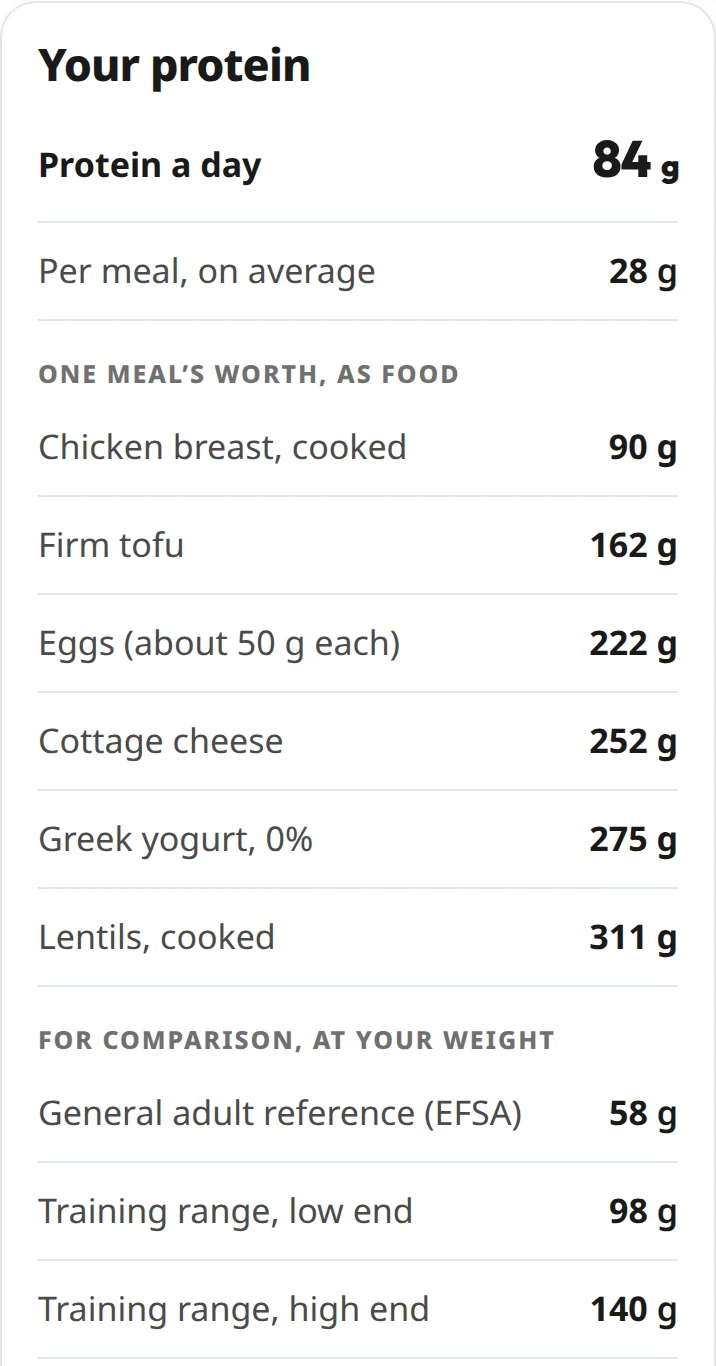
In the app, the diary shows your protein against your target as the day goes, so by lunchtime you can see whether it's on track. Most people only need a week of checking to find where their gap is.
Your first step
Look at tomorrow's breakfast. If it has less than 20 g of protein, swap in skyr, eggs or cottage cheese, and notice whether you're less hungry by eleven.