Wegovy vs Mounjaro: which works better, and what's the difference?
In the only head-to-head trial, Mounjaro averaged 20.2% weight loss against 13.7% on Wegovy. How the two differ, the higher Wegovy dose, side effects and what happens when you stop.
Someone at work is on Mounjaro and has lost more than your friend on Wegovy, and now you're wondering whether you picked the wrong one, or which one to ask your doctor about. They sound like rivals, and in a way they are.
Both are weekly injections that turn your appetite down, and in the only trial that tested them against each other, Mounjaro came out ahead: an average weight loss of 20.2% over 72 weeks, against 13.7% on Wegovy. The side effects are much the same. Which one suits you depends on your health, what your doctor prescribes and what's available and paid for where you live.
Here's how they differ, what the numbers mean for one person, and what happens if you stop.
What's the difference between Wegovy and Mounjaro?
Wegovy is semaglutide, made by Novo Nordisk. It copies GLP-1, a gut hormone that tells your brain you've eaten and slows down how fast your stomach empties. Mounjaro is tirzepatide, made by Lilly. It copies GLP-1 too, and also a second gut hormone called GIP. Acting on both seems to be why it does a bit more.
In daily life they look alike: a pen, once a week, same day each week. Both start at a low dose and go up every four weeks so your stomach can get used to it.
- Wegovy starts at 0.25 mg and climbs to the usual 2.4 mg over about four months. The EU also approved a higher 7.2 mg dose in 2026 for people who need more.
- Mounjaro starts at 2.5 mg and goes up in steps of 2.5 mg, to a maintenance dose of 5, 10 or 15 mg.
Wegovy also comes as a daily tablet now. The Wegovy pill has its own morning routine, which is worth knowing about before you choose it.
Which one makes you lose more weight?
For years the only way to compare them was to put their separate trials side by side. Wegovy's main trial, STEP 1, gave an average loss of 14.9% over 68 weeks. Mounjaro's, SURMOUNT-1, gave 20.9% on the highest dose over 72 weeks. Different people, different years, so it was a rough guide at best.
Then Lilly ran SURMOUNT-5, which gave 751 adults with obesity either Mounjaro or Wegovy, each at the highest dose they could tolerate.
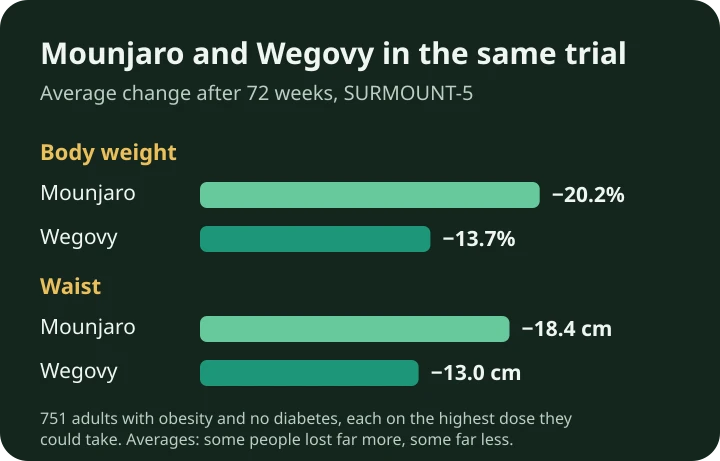
For someone starting at 100 kg, that's roughly 20 kg against 14 kg. Mounjaro also got more people past 20% and 25% of their starting weight. Lilly paid for the trial, which is worth keeping in mind, but the result matches what the separate trials suggested.
The averages hide a wide spread, though. Some people lose a lot on Wegovy and little on Mounjaro, and some don't respond much to either. Your doctor will usually give a dose a few months before judging how it's working for you.
What about the higher Wegovy dose?
That's Novo Nordisk's answer. In STEP UP, adults on 7.2 mg a week lost an average of 18.7% over 72 weeks, against 15.6% on the usual 2.4 mg. That puts it close to Mounjaro, although no trial has compared the two directly yet. The cost was more side effects: 71% had stomach trouble at some point, against 61% on 2.4 mg, and almost a quarter noticed odd skin sensations like tingling, against 6%.
Are the side effects different?
Not much. On both, the common ones are nausea, diarrhoea, constipation and vomiting, mostly mild to moderate and mostly in the weeks when the dose goes up. Eating smaller meals, stopping before you feel full and going easy on fatty food helps on either. Anything severe, like stomach pain that won't go away, is a reason to call your doctor that day.
What happens when you stop?
On either medicine, most of the weight tends to come back. In SURMOUNT-4, people who'd lost about 21% on Mounjaro and then switched to a placebo regained 14% of their body weight over the next year, while those who stayed on it lost a little more. A follow-up of STEP 1 found people had regained about two-thirds of what they'd lost on Wegovy a year after stopping.
So the time on them is a good time to practise the habits that outlast the prescription: learning what a normal portion looks like for you, eating enough protein and keeping some muscle.
So which one should you choose?
That decision belongs with your doctor, because it depends on things an article can't see: your other conditions and medication, whether you have diabetes, what you've tried before, and what's prescribed and reimbursed in your country. The price differs a lot between countries and insurers, and supply has been patchy for both at times. If you're already on one and it works, the trial results aren't a reason to switch by themselves.
What to eat on either one
The eating side is the same for both. When you're not hungry, the calories mostly look after themselves and protein is the number that slips, which is how people lose more muscle than they'd like. Aim for protein at every meal, eat it first while you still have room, and keep fibre and water up. This guide to eating on Mounjaro or Wegovy goes through portions, low-appetite days and the protein target in detail.
A week or two of logging shows whether you're actually getting there. In Ampsu the diary shows protein next to calories for every meal, so a short day is obvious by lunchtime, and the protein calculator gives you a target to aim at.
Your first step
If you're about to talk to your doctor, write down your questions first: which one they'd suggest for you and why, what it costs where you live, and what the plan is for coming off it. Ten minutes goes quickly, and a list means you don't remember the third question on the bus home.