Reverse dieting: does it fix your metabolism?
Reverse dieting promises to repair your metabolism after a diet, but no trial backs that. What really happens after weight loss and how to find your new maintenance.

Reverse dieting means raising your calories slowly after a diet, often by 50 to 100 kcal a week, instead of jumping straight back to normal eating. Fans say it "repairs your metabolism" so you can eat more without regaining. There's no controlled trial showing that, and we looked. What it can do is help you find your real maintenance calories without a rebound, which is genuinely useful. You just don't need a slow, ritual ramp to get there.
Coming off a diet is where a lot of hard-won progress goes to die, so it deserves a plan. Here's what's real, what's marketing, and what to do in the weeks after you hit your goal.
Does your metabolism slow down after a diet?
Yes, a bit more than your smaller size alone would explain. In a carefully measured inpatient study, people who lost 10% of their weight burned less energy than predicted from the weight and tissue they'd lost, both at rest and in their daily movement. Part of that is your body getting more efficient, and part is that people tend to move less when they eat less, often without noticing.
So your maintenance after a diet is usually lower than it was before, and lower than a calculator using your new weight might guess. That's the problem reverse dieting claims to solve.
Does reverse dieting work?
The honest answer is that nobody has properly tested it. We couldn't find a single controlled trial comparing a slow calorie ramp with going straight to maintenance. The popular claims, that it "raises your metabolism" or lets you settle at far more calories than before, come from coaches' experience and before-and-after posts, not research.
That doesn't mean it's useless. A slow increase does two sensible things: it keeps you in a small deficit for a few more weeks, and it stops a post-diet free-for-all. But a planned step up to a realistic maintenance figure does both too, faster.
Why the scale goes up when you eat more
When you add calories after a diet, especially carbohydrate, the scale usually rises 1 to 2 kg in the first week or two. That's mostly water stored with carbohydrate and more food in your gut, not fat. A lot of people panic at this point and cut back again, which is exactly the yo-yo they were trying to avoid. Expect it, and judge your weekly average after three or four weeks instead.
How to come off a diet
- Find your real maintenance. Your best estimate is what you were eating plus the calorie value of what you were still losing. Ampsu works this out from your log and weigh-ins.
- Step up in one or two moves rather than ten. For example, add half the gap this week and the rest next week.
- Expect a kilo or two of water. Don't react to it.
- Keep protein and training the same. They protect the muscle you kept during the diet.
- Watch the trend for four weeks. If it keeps creeping up, trim 100 to 200 kcal. If it's steady, you've found maintenance.
How Ampsu helps after a diet
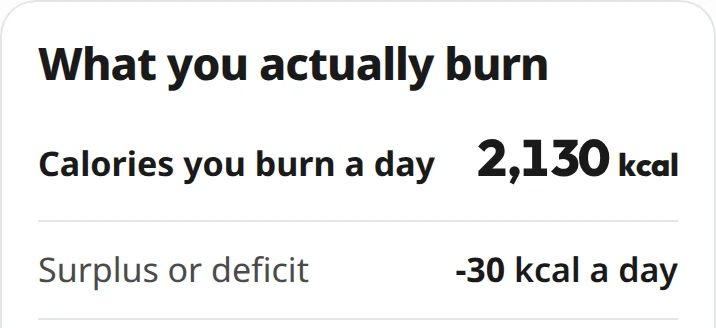
This is where learning your burn from real data pays off. Ampsu compares what you log with how your weight trend moves and estimates what you actually burn, so the "what's my maintenance now?" question has an answer based on you rather than a formula. You can try the same idea in the actual burn calculator with your own numbers. If the number looks low, that's normal after a diet, and it often creeps back up as you move more and train harder. For a rough starting point before you have weeks of data, the TDEE calculator gives an estimate.
Your first step
When you reach your goal, don't celebrate with a week of eating everything. Look up your real maintenance estimate, add half the gap to your daily calories, and keep weighing in. Next week, add the rest.