Kebab calories: döner, shish, wraps and kebab plates
A normal döner kebab in bread has about 600 to 870 kcal, a shish closer to 520 and a plate with chips over 1,200. What changes the number and how to log it.
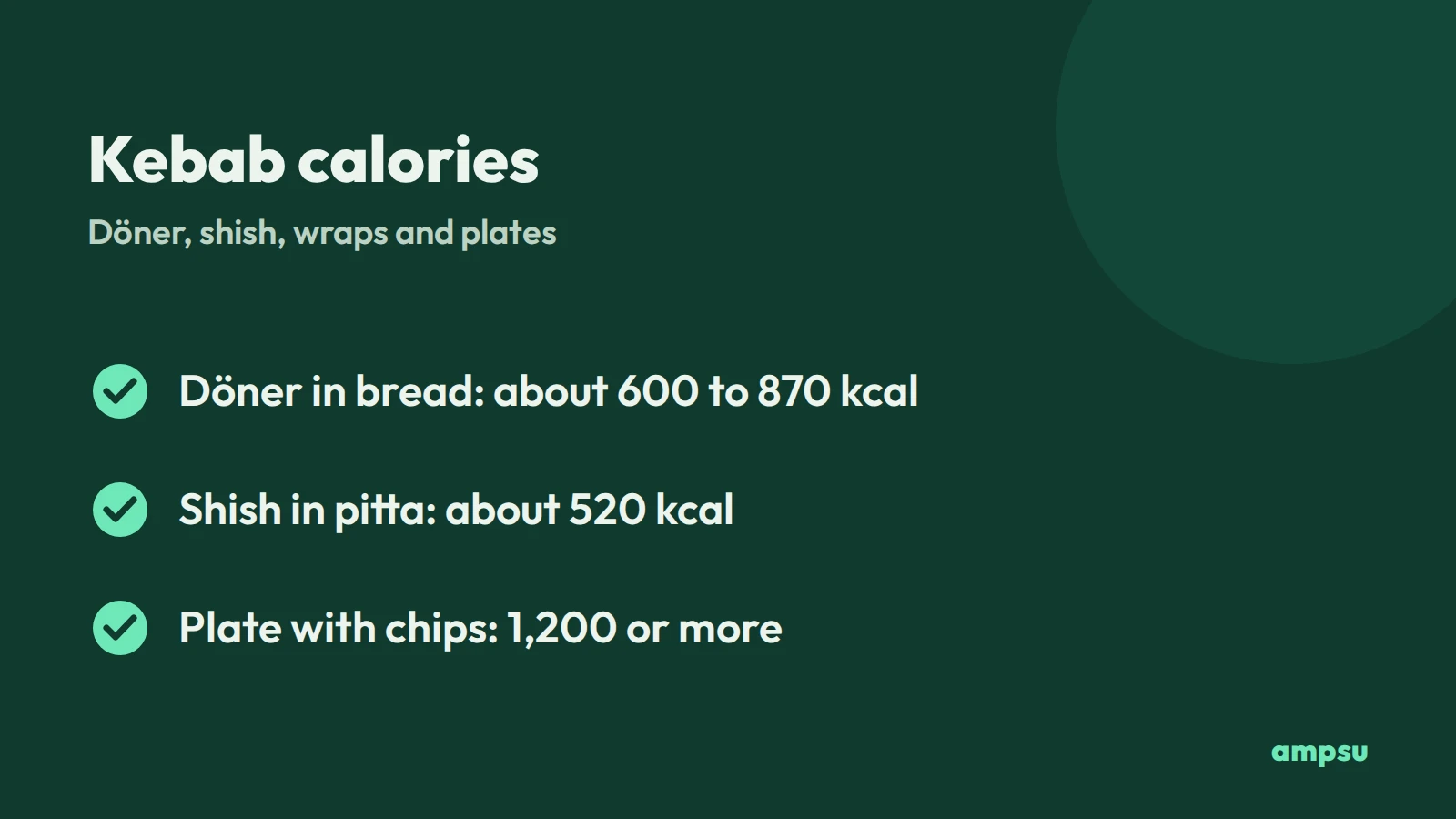
A normal döner kebab in bread has about 600 to 870 kcal. That's going by European national food tables and a typical shop kebab of around 350 g. A shish kebab in pitta is closer to 520. A kebab plate with chips easily passes 1,200, and a Dutch kapsalon heads for 1,500.
The range is wide because "a kebab" is four or five decisions in one: the meat, the bread, the sauce, the size, and whether chips are involved. Here's what each one does to the number, and how to log it without pretending you weighed anything at 1 am.
How many calories are in a döner kebab?
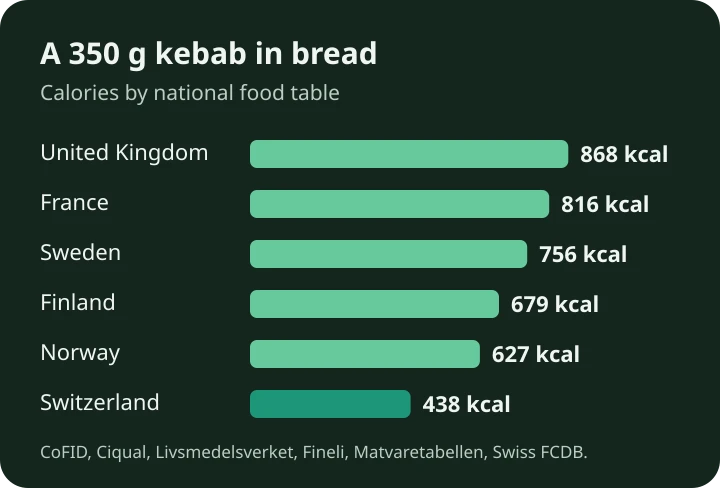
Every national food table that lists one gives a slightly different kebab, which is honest of them, because kebab shops do too. Per 100 g of kebab in bread with salad and sauce, the UK's CoFID has 248 kcal, France's Ciqual 233, Sweden's Livsmedelsverket 216, Finland's Fineli 194 and Norway's Matvaretabellen 179. Switzerland's is the outlier at 125, so recipes really do differ.
The weight decides the rest. People logging döner in the German food database FDDB most often enter about 350 g for a normal one, and that's where the 600 to 870 kcal comes from. A big one from a generous shop can be 450 g or more, which adds another 200 or so.
Where do the calories come from?
Roughly, for a 350 g kebab:
- The meat, about 120 g: 250 to 450 kcal. Restaurant kebab meat runs from 280 to 377 kcal per 100 g in the Swedish, Norwegian and UK tables, because it's pressed from fattier cuts so it stays juicy on the spit.
- The bread, about 110 g: around 285 kcal. Pitta and flatbread are mostly flour and not much fat.
- The sauce, about 40 g: 30 kcal for a yoghurt sauce, or 120 for a creamy white kebab sauce at 30% fat, and more if it's mayonnaise-based.
- The salad: 20 kcal or so. It's there for crunch, and it does its job.
So the meat and the sauce swing the total. The bread is the steady part.
Which kebab has the fewest calories?
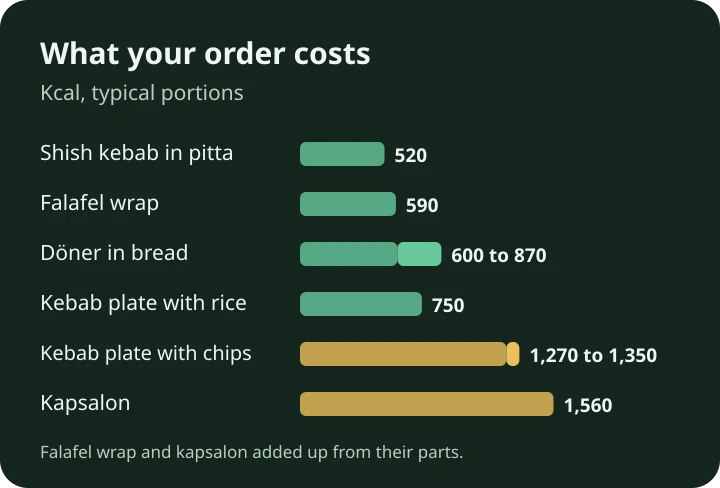
A shish kebab, grilled cubes of meat on a skewer rather than a pressed spit, is the lightest of the classics. CoFID puts shish in pitta with salad at 149 kcal per 100 g, so a 350 g one is about 520 kcal, with almost as much protein as a döner.
A falafel wrap lands around 590 kcal if you count four or five fried falafel at about 250 kcal per 100 g, plus bread, salad and a yoghurt sauce. Chicken döner tends to be lighter than lamb or beef. The median chicken kebab label in Ampsu's catalogue is 160 kcal per 100 g of meat, against 280 to 377 for restaurant beef and lamb mixes.
What about a kebab plate with chips?
That's where the number jumps. Finland's table has a kebab with chips at 269 kcal per 100 g and Sweden's kebab plate with chips at 254. A 500 g plate comes to about 1,270 to 1,350 kcal. Swap the chips for rice and Fineli's version drops to 150 kcal per 100 g, about 750 kcal for the same plate.
The Dutch kapsalon stacks chips, kebab meat, melted Gouda, salad and garlic sauce in one tray. There's no national table entry for it, but adding up 250 g of chips, 150 g of meat, 60 g of cheese and 50 g of sauce from the tables gives about 1,560 kcal. Delicious, and roughly three-quarters of a day for a lot of people.
Can you eat a kebab on a diet?
Yes. One kebab doesn't decide anything; what you eat across the week does. If a kebab is a regular Friday thing, a few swaps make it fit more easily:
- Ask for chicken, or shish if they do it.
- Go for the yoghurt or garlic yoghurt sauce, or ask for the white sauce on the side and use half.
- Pick bread or chips, not both. A kebab in bread with a side salad is around half a kapsalon.
- Take extra salad. It's free, and it makes the same kebab more filling.
And if it's an occasional treat, enjoy it and log it. This explainer on calorie deficits shows why one evening matters much less than the average.
How to log a kebab in Ampsu
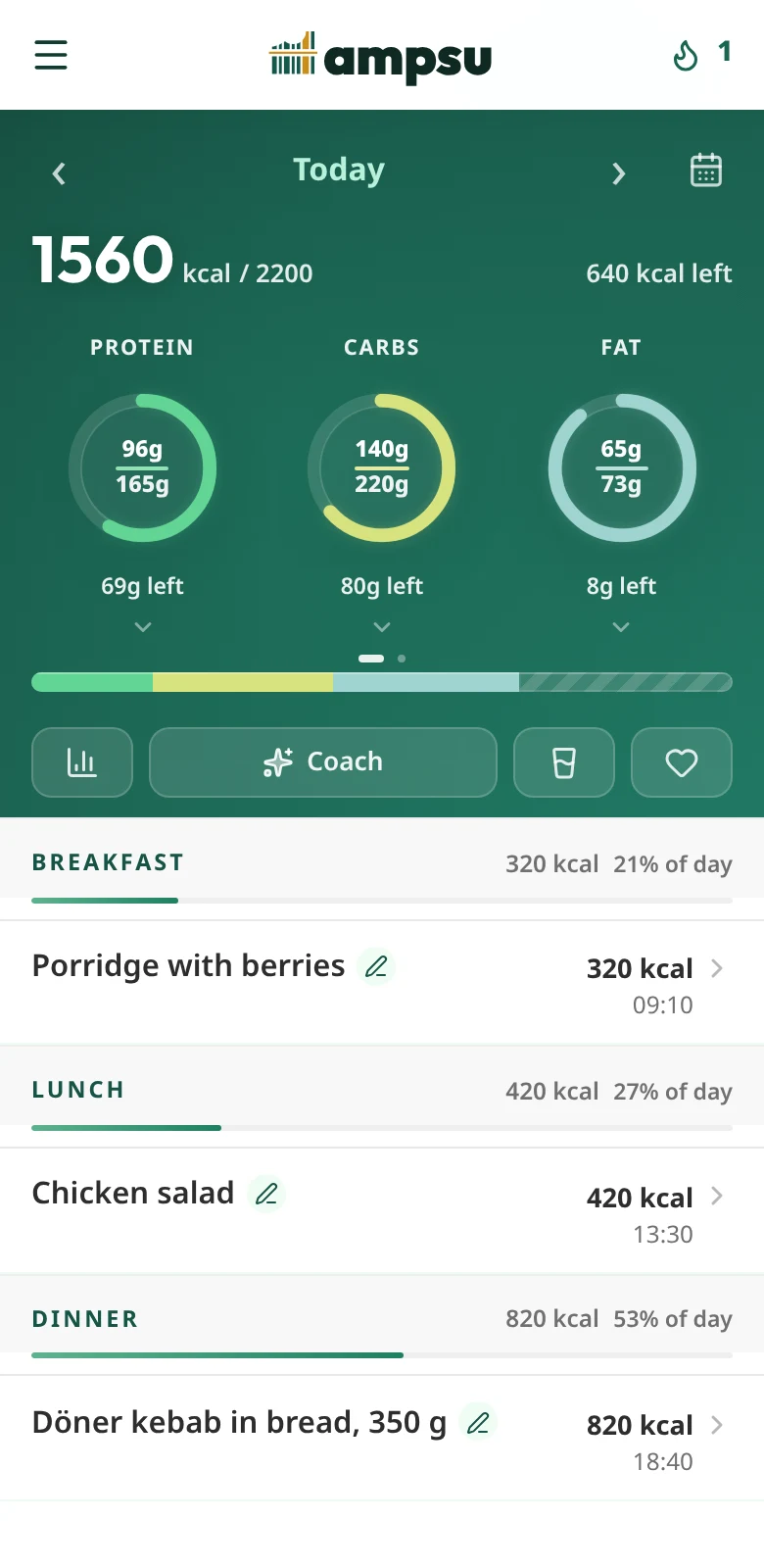
Search for "kebab" or "döner" and pick the version closest to yours, kebab in bread, plate with chips or plate with rice, then enter the weight. If you don't know it, 350 g is a fair guess for a normal kebab in bread. Logging a sensible estimate beats skipping it: a skipped kebab is a 0 in your diary, and a guessed one is wrong by maybe 100 kcal.
If you'd rather check the number before ordering, the TDEE calculator gives you a daily target to fit it into.
Your first step
Next time you order, notice which sauce they put on and whether there's chips in the picture. Those two choices move the number more than anything else.