Incline walking vs running, rucking and cycling: calories compared
Half an hour of 12% incline walking burns about 270 kcal at 75 kg, close to cycling and a jog. Calories compared, why hills work and the lowest-effort option.
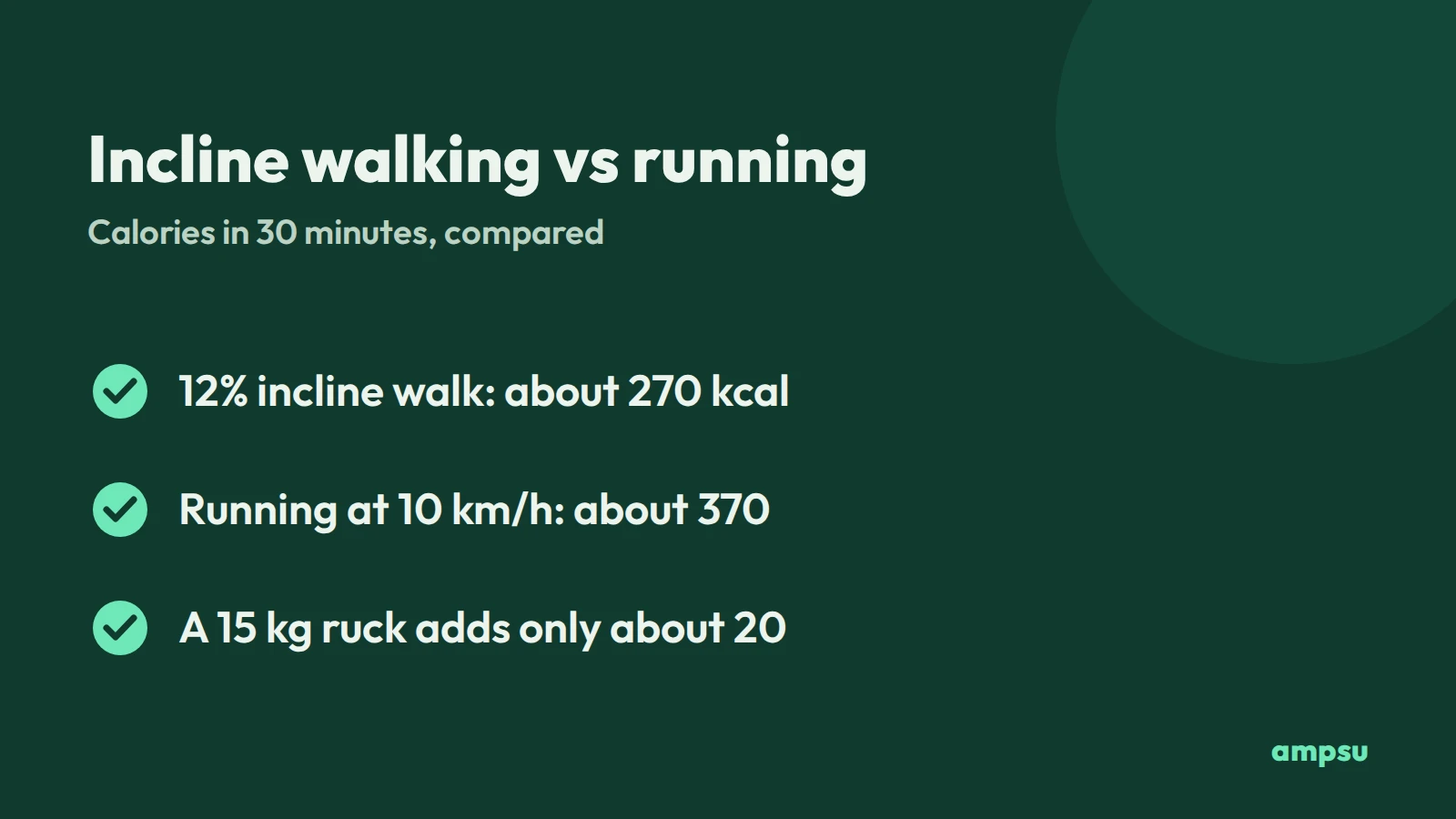
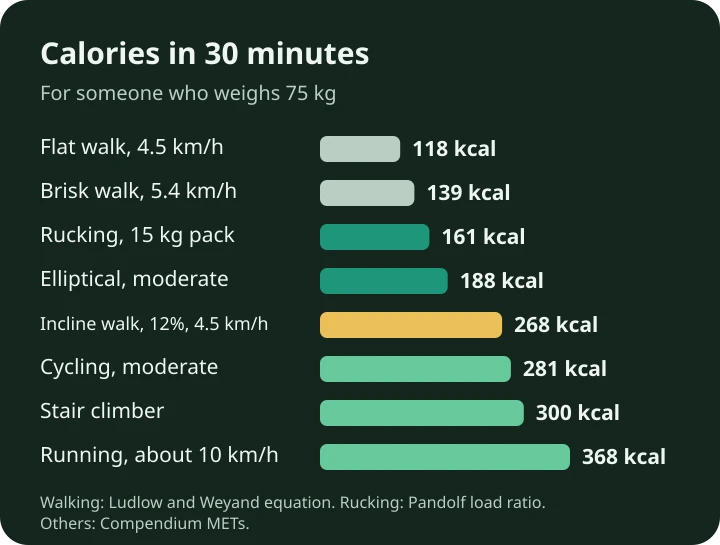
For someone who weighs 75 kg, half an hour of walking at 4.5 km/h on a 12% incline burns about 270 kcal. That's roughly what moderate cycling or a stair climber gives you, not far behind a steady run at about 10 km/h (around 370), and more than twice a flat walk at the same speed (about 120). Rucking with a 15 kg pack on flat ground adds less than you'd think: about 20 kcal per half hour.
So the incline treadmill earns its reputation. It's basically running with your dignity intact: a pace you can hold a conversation at, for a burn close to a jog. Here's how the options compare, why the hill does so much work, and which one is actually the lowest effort.
How many calories does incline walking burn?
The best walking equation we know of, from Ludlow and Weyand, predicts the cost of walking from your speed, the gradient and your weight. In a 2021 comparison against measured walking, it came within about 4%, against 13% for the equation most calculators use. It's also the one inside Ampsu's steps calculator.
Its main message is that gradient is expensive. At 4.5 km/h, each extra percent of incline adds a chunk of work, because you're lifting your whole body a little with every step. Going from flat to 12% roughly multiplies the burn by 2.3. Speed matters too, but less than people expect at walking pace.
The viral "12-3-30" workout, named like a Wi-Fi password, is 12% incline, 3 mph (about 4.8 km/h) and 30 minutes. For 75 kg that's about 290 kcal. One condition: don't hold the handrails. Leaning on them takes weight off your legs, and the numbers above stop applying.
Is running better than incline walking?
Per minute, running burns more. At about 10 km/h, the Compendium of Physical Activities puts running at around 9.8 times your resting rate, which is about 370 kcal in 30 minutes for 75 kg. But it's also much harder to keep up, it pounds your knees and ankles more, and plenty of people can't run for 30 minutes at all when they start.
If the choice is 30 minutes of incline walking you'll do four times a week, or a run you'll dread and skip, the walk wins on the only number that matters: the weekly total.
Does rucking burn more calories?
Less than its fans suggest, at least on flat ground. Rucking is walking with a loaded backpack. The classic Pandolf equation for load carriage says a 15 kg pack raises the cost of a brisk flat walk by around 15%, which is about 20 kcal in half an hour for someone who weighs 75 kg.
Where rucking does shine is hills. The extra weight multiplies with the gradient, so a weighted walk up a long slope gets expensive fast. If you live somewhere flat, an incline treadmill does more for your calorie burn than a heavy backpack, and it's kinder to your shoulders.
What about cycling, stairs and the elliptical?
- Cycling, moderate effort: about 280 kcal in 30 minutes. Easy on the joints, and commuting by bike counts. A gentle ride to the shops is closer to half that.
- Stair climber: about 300 kcal. Basically incline walking at its steepest, with the same handrail caveat.
- Elliptical, moderate: about 190 kcal. Lower than its reputation, and its built-in calorie counter is a guess like any other.
What's the lowest-effort way to burn calories?
Honestly, walking more during the day. Steps add up without feeling like exercise, and nobody has ever had to psych themselves up for a walk to the bakery. Ampsu's steps calculator shows that 10,000 steps at an average pace is around 370 kcal for 75 kg, more than most single workouts.
After that, the lowest-effort workout is incline walking: a big burn per minute for a moderate effort, at a pace where you can watch something. Running burns the most per minute if you enjoy it. Whatever you choose, remember that exercise is a small slice of a day's calories next to what you eat. This explainer on calorie deficits puts it in proportion.
How to log incline walking in Ampsu
Ampsu's steps calculator takes an incline, so you can see what a treadmill session is worth before you log it. Enter your steps, height, weight and pace, set the incline, and it works out the burn and the time.
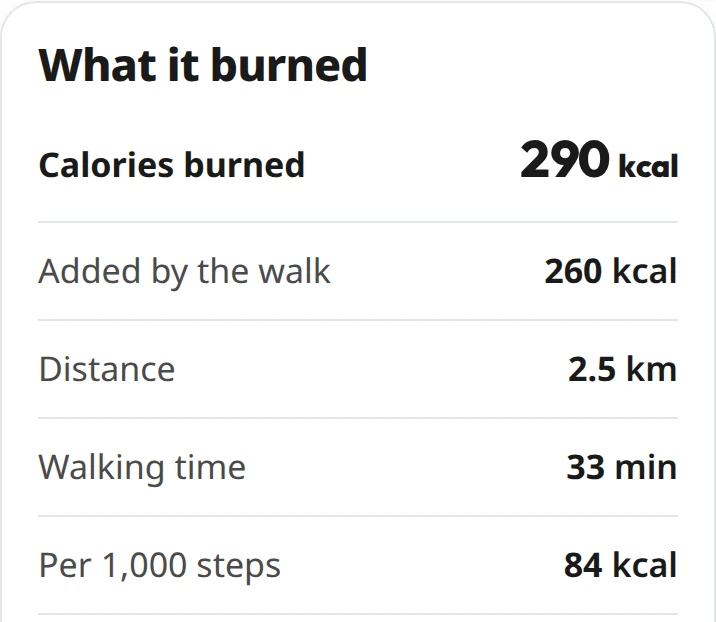
In the app you can log the session as a workout, or let steps and workouts sync from your watch or phone. Ampsu then folds them into your real burn over the weeks, so one generous treadmill display doesn't throw your numbers off.
Your first step
Next time you're on a treadmill, try 10 minutes at 8 to 12% incline at a pace where you can still talk. It's the cheapest upgrade in the gym.