How many calories in an avocado? Half, whole and on toast
Half a medium avocado has about 130 kcal and a whole one about 265. Calories by size, why avocado is so dense, what the big trial found and how to log it.
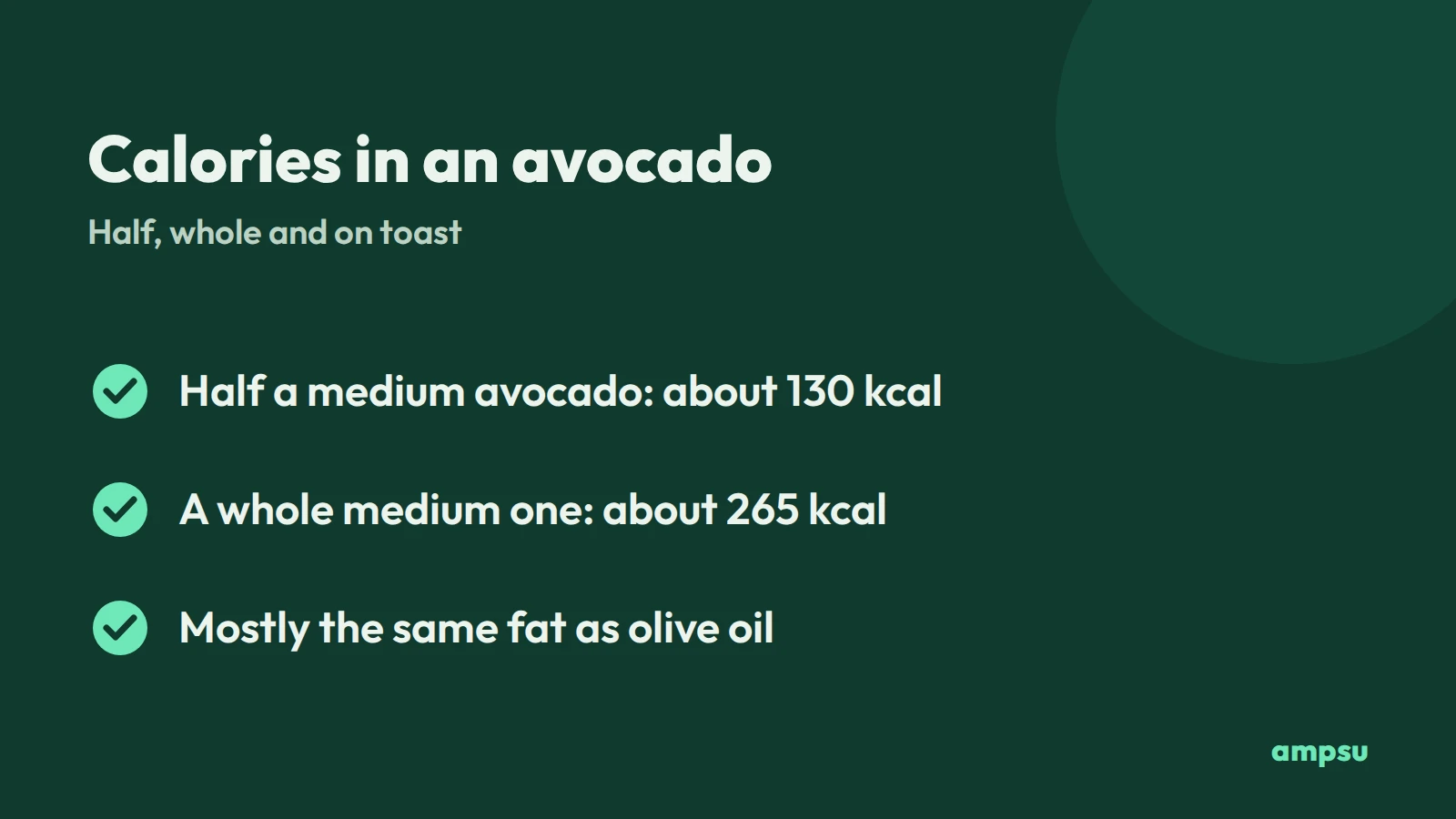
Half a medium avocado has about 130 kcal, and a whole one about 265. A small avocado is closer to 200 for the whole fruit, a large one about 330. Most of that comes from fat, the same kind as in olive oil, along with a decent amount of fibre.
So it's a calorie-dense fruit, roughly twice a banana gram for gram. That doesn't make it a bad choice. It just means the portion is worth knowing, especially when it's spread thick on toast.
How many calories are in an avocado?
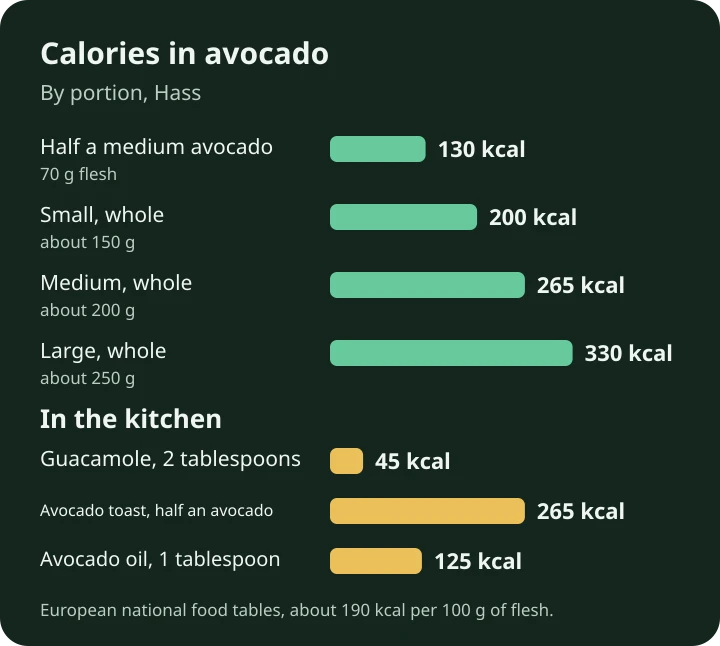
Avocado flesh has between 171 and 205 kcal per 100 g in the European national food tables: 171 for Hass in the UK's CoFID, 176 in Portugal's INSA table, 197 in Sweden's Livsmedelsverket, 198 in Finland's Fineli and 205 in France's Ciqual. The spread is real: avocados differ in oil content by variety and how ripe they are. About 190 kcal per 100 g is a fair middle.
The skin and stone are roughly 30% of the fruit. CoFID and Fineli both list avocado with and without them, and the edible part comes out at 69 to 71%. So for Hass, the dark, bumpy kind most European shops sell:
- Half a medium avocado, about 70 g of flesh: about 130 kcal
- Small avocado, about 150 g whole: about 200 kcal
- Medium avocado, about 200 g whole: about 265 kcal
- Large avocado, about 250 g whole: about 330 kcal
Half a medium avocado brings about 13 g of fat, 3 to 4 g of fibre and just over 1 g of protein, with very little sugar.
Why is avocado so high in calories?
Because it's about 17 to 20% fat, which is unusual for a fruit. Most of that is monounsaturated fat, the type that makes up most of olive oil, and only 2 to 4.5 g per 100 g is saturated. Fat has 9 kcal per gram against 4 for carbohydrate, so a fruit made of fat and water ends up dense.
The fat isn't a problem on its own. It does mean a generous avocado can quietly be the biggest number on the plate. The flesh of a large one is about as many calories as a small bowl of pasta.
Does eating avocado make you gain weight?
Not by itself, going by the biggest trial so far. In the Habitual Diet and Avocado Trial, about 1,000 adults with a larger waist either added one large avocado a day to their diet for six months or carried on as usual. Body weight changed about the same in both groups, belly fat measured by MRI didn't differ, and LDL cholesterol dropped slightly in the avocado group.
Nobody was told to eat less of anything else, which suggests people made room for the avocado without trying. It also didn't melt belly fat, whatever the internet says. It's a filling food that fits into a normal diet, not a fat-loss tool.
Avocado toast, guacamole and avocado oil
- Avocado toast: a slice of sourdough at about 130 kcal plus half an avocado is around 265 kcal. Add a poached egg and it's about 335.
- Guacamole: 128 to 159 kcal per 100 g in the CoFID and Fineli homemade versions, since the lime, onion and tomato thin it out. Two tablespoons, about 30 g, are roughly 40 to 50 kcal. The crisps you scoop it with usually count for more.
- Avocado oil: 884 kcal per 100 g like any oil, so a tablespoon of about 14 g is around 125.
How to log an avocado in Ampsu
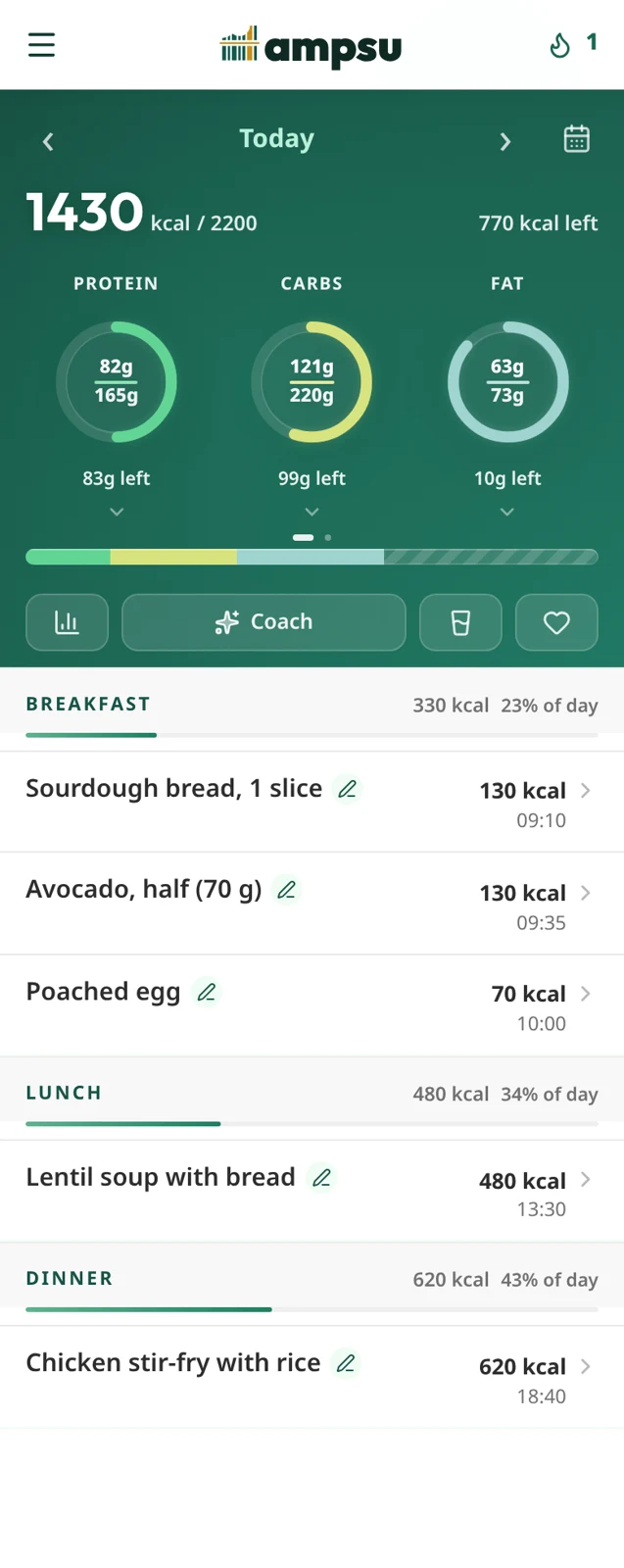
The most accurate way is to weigh the flesh after scooping it out, then search for "avocado" and enter that weight. If you only know you ate half a medium one, about 70 g is a good estimate. Avocado is one of the foods where guessing high is safer than guessing low, because the difference between a thin layer and a thick one is easily 100 kcal.
For other everyday foods, this page on calories in a banana works the same way. And if you're working out your daily number, the TDEE calculator gives you a starting point.
Your first step
Next time you make avocado toast, weigh the avocado you spread on it. Most people are surprised in one direction or the other, and after that one check you'll know your usual portion.